


When large enterprises adjust their AI strategies, it is worth taking a closer look from an SME perspective. Not because family businesses and smaller organisations should copy these approaches, but because the bottlenecks that corporations are currently encountering are structurally similar to those already present in SMEs. This article contextualises recent observations from the enterprise world, translates them into the reality of SMEs and family businesses, and introduces the AI Transformation Matrix – a diagnostic tool that makes visible what matters most at each phase.
TL;DR:
The AI bottlenecks that large enterprises are currently identifying – insufficient change management, fragmented systems, unclear use cases – already exist in SMEs and family businesses. The difference is not one of timing, but of visibility: corporations have AI leads and strategy departments that can name and address these challenges. SMEs often lack the framework to do so. The AI Transformation Matrix connects five phases of AI maturity with four guiding questions and reveals where the specific obstacles lie at each stage. The advantage for SMEs: shorter decision-making paths and less bureaucracy enable faster action – provided AI is not misunderstood as an IT project.
What is becoming relevant for large enterprises in the AI context?
Aaron Levie, CEO of Box and one of the most prominent voices in enterprise software, shared his observations from dozens of conversations with IT and AI leaders at major corporations in mid-April 2026 [1]. Among them were representatives from banking, media, retail, healthcare, and consulting – feedback from across many industries. His assessment is instructive because much of what Levie describes sounds familiar.
From experimentation to strategy: Organisations are moving away from a “many AI experiments” approach towards targeted automation of specific workflows. This sounds like progress. But it also means that the phase of uncoordinated experimentation appears to have passed, even at large enterprises.
Change management as the central challenge: Most workflows are not designed for AI agents to simply take over. Organisations require substantial support to implement the necessary foundations and adjustments across the entire business. Levie cites one company, for instance, that has installed a head of AI in every business unit, all reporting to a central team – purely to maintain coordination. [Change Management – The Underestimated Success Factor in AI Implementations]
Fragmented systems as an obstacle: Most organisations are contending with decades of legacy IT landscapes. Systems that may have been migrated to the cloud but were never truly modernised. AI agents cannot access these data sources in a unified way. [Data Quality and AI – Why Most Organisations Start at the Wrong End]
From chat to agents: Large enterprises are moving from the chat era of AI to agents that use tools, process data, and carry out operational work. At the same time, Levie observes that most workflows are not prepared for this transition. Without documented processes, without accessible data, without clear governance, agents remain a promise without a foundation.
Everyone is working more, not less: Without exception, all of Levie’s conversation partners report that AI is not currently leading to a reduction in workload. On the contrary: teams are busier than ever. [AI Makes Us More Productive – And That Is Precisely the Danger]
What can SMEs derive from this for their own strategic AI positioning?
A natural reaction from the SME sector to Levie’s observations might be: “That concerns large corporations, not us. We still have time.”
This assessment is understandable, but it does not always correspond to reality.
The bottlenecks that Levie observes at large enterprises are not future challenges that have yet to reach SMEs. They are already present. The difference lies not in timing, but in their visibility and the resources available to address them.
Large enterprises deploy AI leads, maintain strategy departments that systematically analyse bottlenecks, or engage external consultants who provide frameworks. Put differently: when a corporation concludes that change management is its central AI obstacle, it can often draw on established structures and the necessary resources to address this challenge.
Which challenges do SMEs and large enterprises share – and where do the options for action differ?
Viewed through the lens of an SME, it becomes clear that the challenges in the AI context are structurally similar, but that there is typically no function yet that articulates them and actively works to overcome them.
What is diagnosed as “fragmented legacy systems” at large enterprises translates, in an SME context, to one SAP installation, three Excel silos, and an ERP module bolted on top. Add to that knowledge which resides solely in the heads of the most experienced employees. [Tribal Knowledge – Why Informal Operational Knowledge Is the Blind Spot of Every AI Implementation]
What is described as “let a thousand flowers bloom” at corporations means, in an SME: individual employees use ChatGPT, the sales director has a Copilot licence, but fundamental work on business processes has not yet begun. [The Imagination Gap – Why Imagination Is the Real AI Bottleneck]
What is recognised as a change management challenge at large enterprises often remains invisible in SMEs – because AI is still treated as an IT matter rather than an organisational transformation.
In short: the challenges are the same. Only how they are articulated and responded to differs.
Why is AI transformation not comparable to an IT roll out?
SMEs and family businesses have accumulated their experiences with technology projects over decades. Company-wide software rollouts that took years. ERP migrations that exceeded their budgets. Digitalisation initiatives that only truly worked after the second or third attempt. And even then, it typically took months before all employees had genuinely understood the new system.
This experience has created a mental category: “IT projects take forever, cost a great deal, and take even longer before the technology is understood by everyone.”
AI is placed into precisely this category. And that is a misjudgement.
AI transformation is not a software rollout. The investment required is different. The pace of iteration is more dynamic. The barrier to entry is lower. A team can become more productive with AI within a week, provided the right conditions are in place. Rolling out an ERP module in a week, by contrast, is a different proposition entirely.
Why do SMEs have precisely the strengths that matter for AI transformation?
Here, a paradox reveals itself: SMEs and family businesses possess exactly the strengths that are decisive for a successful AI transformation. Short decision-making paths. Fewer alignment loops, less bureaucracy, fewer internal politics.
Yet, these strengths often go unused – because “AI” is mistakenly categorised as a software matter that requires patience, large budgets, and extended timescales.
The good news: organisations that recognise this miscategorisation gain an advantage. Not over corporations, but over competitors who remain caught in the same thinking.
How does the AI Transformation Matrix make bottlenecks visible?
Which questions need to be asked so that an initial diagnosis reveals where the organisation stands, what requires attention now, and which topics should be addressed first?
The AI Transformation Matrix serves as an initial guide. It connects two dimensions: the five phases that an organisation passes through during AI transformation, coupled with four guiding questions that describe what is particularly relevant at each phase.
The four guiding questions:
WHAT are we doing with AI? Are there prioritised use cases, or does the necessary clarity not yet exist?
WHAT are we building on? Are data, processes, and context prepared in a way that enables AI to work productively?
WHO can do this? Do the right people have the competence to work with AI?
WHO decides? Are there clear responsibilities, governance structures, and escalation paths?
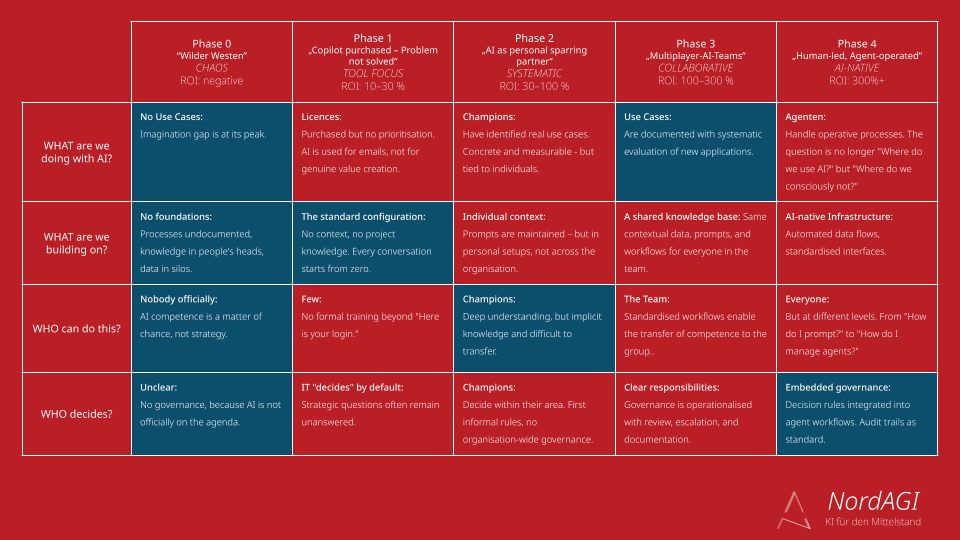
At each phase, different guiding questions address the primary bottleneck.
Phase 1: Organisations stuck in Phase 1 (“Copilot purchased, problem not solved”) are not failing at everything simultaneously. The primary question to answer is “WHAT are we building on?” AI is deployed on top of a standard configuration in this phase – no context, no project knowledge. Every conversation starts from zero. The consequence: the tool works technically, but it has nothing to build upon, and therefore cannot deliver its potential impact.
Phase 2: Individual champions are already using AI as a genuine sparring partner. They have identified real use cases – concrete and measurable. The bottleneck shifts to “WHO can do this?” The champions lead the way, their understanding runs deep, but it remains implicit and difficult to transfer. Prompts are maintained, but in personal setups rather than across the organisation.
Phase 3: Teams work collaboratively with AI. At this point, the question “WHAT are we doing with AI?” becomes central: use cases must be transferred from individual people to organisation-wide processes. What was previously a personal setup must be systematised and documented. At the same time, the organisation builds on a shared knowledge base – the same contextual data, prompts, and workflows available to everyone in the team. [AI in Manufacturing – Different Shop Floor, Similar Challenges?]
Phase 4: AI agents carry out operational processes autonomously. The focus then shifts to “WHO decides?” Autonomous systems require embedded governance – decision rules integrated into agent workflows, with audit trails as standard.
The matrix is not an academic model. It is an initial diagnostic tool. Answering the four questions honestly reveals, within a short time, which phase an organisation is in and where the concrete levers are.
What specific advantages do SMEs have?
Large enterprises establish elaborate internal processes to allocate AI budgets and resources, build governance hierarchies, and work on the interoperability of various AI systems. SMEs and family businesses do not have this friction. The managing director can work through the four guiding questions with a leadership team in an afternoon meeting and then take initial directional decisions. That is the structural advantage of short decision-making paths.
The real challenge comes afterwards: which tools do we deploy? What does the technical implementation look like? How do we ensure that the initial momentum does not dissipate in day-to-day operations? These questions cannot be answered in a single afternoon, but they can be addressed in parallel with the rollout.
Our approach: use the matrix as a starting point to identify the most pressing bottlenecks, and then initiate the first steps. At the same time, it is worth developing an AI strategy that provides the bigger picture – from tool selection to process adjustments to employee qualification. The matrix shows where an organisation stands. The AI strategy charts the path to the goal, brings all activities together, and ensures alignment with the overall business strategy.
The advantage that SMEs hold is real. But it only becomes a competitive edge when organisations move beyond Phases 0 and 1, and stop treating AI as an IT project.
A quick diagnostic for your organisation
The following questions connect directly to the guiding questions of the matrix and provide, in just a few minutes, an initial indication of which phase your organisation is currently in – and where the greatest lever lies.
1. Do you know precisely which three processes in your organisation would benefit most from AI – or are employees still experimenting on their initiative?
If those three processes cannot be named, the answer to the question “WHAT” is missing. This is not a criticism – it is the Imagination Gap that exists in most organisations.
2. If a new employee started tomorrow: is there documented knowledge that this person could draw upon – or does everything reside in the heads of your most experienced people?
This question tests “WHAT ARE WE BUILDING ON”. And it carries an urgency that extends beyond AI: every piece of undocumented knowledge is a risk – regardless of whether AI is being deployed or not.
3. Does your leadership team use AI regularly for sparring and decision-making – or has this been delegated to “the younger staff” or the IT department?
“WHO CAN DO THIS” starts at the top. If the leadership team does not use AI itself, it lacks the foundation to evaluate AI strategies, allocate resources, and bring the organisation along.
4. Are there clear rules in your organisation for when AI outputs must be reviewed by a person – and who is responsible for doing so?
“WHO DECIDES” may sound like a question for Phase 4. But even in Phases 1 and 2, basic rules are needed. Without them, there is a risk that errors only become visible once they have consequences.
5. Could you name a recurring process today that an AI agent might handle autonomously within twelve months?
If so: the organisation is already thinking in terms of Phase 3 or 4. If not: developing precisely this capacity for imagination is the first and most important step.
None of these questions requires a budget. None requires a technology decision. But each one reveals where an organisation stands – and what comes next.
Sources: [1] Aaron Levie (@levie), X – https://x.com/levie/status/2043426157367095397/?s=20&rw_tt_thread=True
Lorem ipsum dolor sit amet
Lorem ipsum dolor sit amet, consetetur sadipscing elitr, sed diam nonumy eirmod tempor invidunt ut labore et dolore magna aliquyam erat, sed diam voluptua. At vero eos et accusam et justo duo dolores et ea rebum. Stet clita kasd gubergren, no sea takimata sanctus est Lorem ipsum dolor sit amet. Lorem ipsum dolor sit amet, consetetur sadipscing elitr, sed diam
Lorem ipsum dolor sit amet, consetetur sadipscing elitr, sed diam nonumy eirmod tempor invidunt ut labore et dolore magna aliquyam erat, sed diam voluptua. At vero eos et accusam et justo duo dolores et ea rebum. Stet clita kasd gubergren, no sea takimata sanctus est Lorem ipsum dolor sit amet. Lorem ipsum dolor sit amet, consetetur sadipscing elitr, sed diam
Would you like to strategically implement AI in your daily business operations?
The question is: What does this look like in your company? Do your employees have the competencies they need for this new work reality? Or are AI integration and competency development currently happening side by side – without systematic connection?
In a no-obligation strategy session, we would be happy to introduce you to the NordAGI approach.