



When artificial intelligence in business comes up in conversation, most people think of the typical office context: automated emails, intelligent document processing, customer service chatbots, or AI-assisted content creation for web and social media. AI applications in manufacturing rarely feature in this discussion – and when they do, it tends to be as a futuristic vision of fully autonomous factories staffed by humanoid robots.
Yet a closer look within one’s own organisation can be revealing. Businesses that combine desk-based work and production under one roof are increasingly discovering something striking: the challenges of AI adoption are remarkably similar on both sides. The technology is available. The use cases exist. And yet implementation isn’t progressing at the pace many had hoped – for reasons that have far less to do with technology than with people.
TL;DR:
Where do European SMEs stand on AI in manufacturing?
The data paints a picture that is both sobering and instructive.
Eurostat reports that 20 per cent of EU enterprises used at least one AI technology in 2025 – up from 13.5 per cent the previous year.[2] The gap between large enterprises (55 per cent) and small businesses (17 per cent) remains considerable. Across the DACH region, the picture varies: Germany and Austria each sit at around 20 per cent (2024 survey data). Switzerland, as a non-EU member, is not covered by Eurostat – here, a 2024 study by ETH Zurich offers the most reliable data available. Conducted in partnership with the Swiss industry association Swissmem, the study surveyed 209 senior managers in the Swiss technology sector. The findings: 51 per cent of respondents had not even considered deploying AI in manufacturing.[3] Not rejected it – simply never thought about it. Professor Torbjørn Netland cautioned that surveys by consulting firms tend to systematically overestimate actual adoption rates, owing to biased samples.
For AI adoption specifically in production – rather than in businesses generally – the Fraunhofer ISI’s German Manufacturing Survey provides the best available benchmark: only around 16 per cent of German industrial firms integrate AI directly into their production processes, rising to 30 per cent among large enterprises and falling to 13 per cent among smaller firms.[1] The underlying data dates from 2022, however – given the pace of change in AI, the actual figures today are very likely different, though the general order of magnitude remains a useful point of orientation.
In Germany, the Bitkom industry survey of 2025, covering 552 industrial firms, reveals a telling disconnect: 82 per cent of respondents are convinced that AI will be critical for competitiveness. Yet 50 per cent are pursuing a wait-and-see strategy, watching what others do first. Only 24 per cent believe they are in a position to harness AI’s potential successfully.[4]
Unstructured processes prevent organisations from getting started: Just as AI in office environments depends on documented workflows, AI in manufacturing requires both digitalised, structured data and clearly defined processes.
70 per cent of the challenge is human
For its “Build for the Future” study in 2024, Boston Consulting Group surveyed more than 1,000 senior executives across 59 countries and 20 industries on the state of their AI implementation. Published in October 2024,[5] its central finding was this: 74 per cent of companies struggle to achieve and scale measurable value from AI. Just four per cent possess the advanced capabilities needed to generate significant returns.
An important note on context: This study reflects the state of play in 2024. Since then, AI models have advanced at extraordinary speed – in terms of technological capability, the time between the survey and now feels like an entire generation. Human adaptation to new technologies, by contrast, unfolds in considerably longer cycles. The study’s core arguments – particularly on the importance of people and processes – are therefore likely to remain valid, and may even have grown more relevant: technological possibilities are expanding faster than organisations’ ability to harness them.
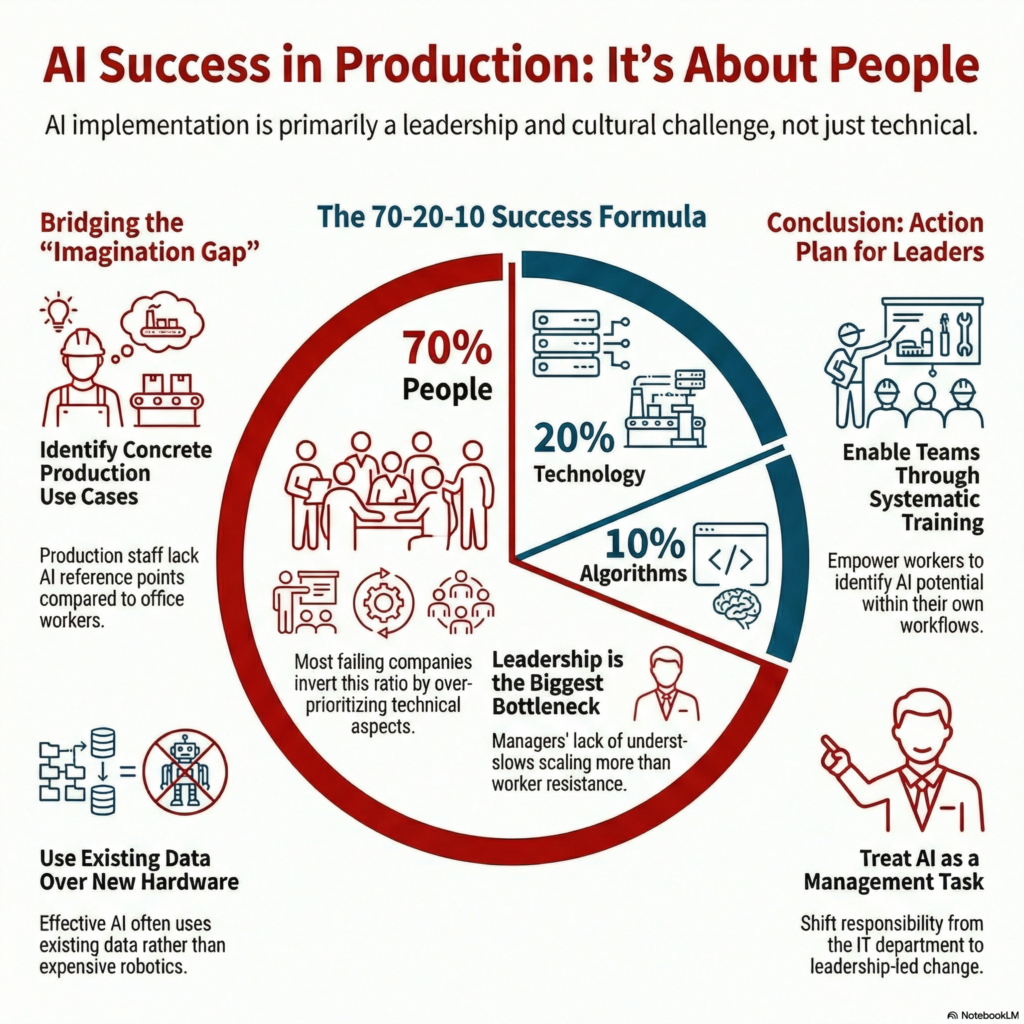
The decisive finding lies in the root-cause analysis. BCG concludes that 70 per cent of implementation effort should be directed at people and processes, 20 per cent at technology, and just 10 per cent at algorithms.[5] The reality in most organisations looks quite different: BCG describes how struggling companies effectively invert this ratio by prioritising technical aspects over human ones. The study does not provide exact counter-figures – but the pattern is clear: where the bulk of attention and resources flows into algorithms and technology, the hoped-for value contribution often fails to materialise.
This pattern will be familiar to anyone who has observed AI adoption in administrative settings. And it repeats itself in manufacturing with remarkable precision:
Employees respond with the same reservations: A 2025 study by Barua et al., published in Scientific Reports (Nature), surveyed 100 manufacturing professionals and conducted 15 supplementary interviews with senior managers in smart manufacturing environments. The result: resistance to change is one of the most thoroughly documented challenges in production settings – with fear of job loss as the central driver.[6] Rockwell Automation’s 2024 global survey of 1,567 manufacturing firms ranked change management as the single greatest people-related obstacle.[7]
Senior management holds back more than employees do: McKinsey’s cross-industry examination of change management in the AI era (August 2025) found that the greatest barrier to scaling AI is not workforce resistance, but a tendency towards inertia at leadership level. Employees already use AI three times more frequently than their managers assume.[8] At the 2025 IIoT World Manufacturing Day conference, representatives from Siemens and Databricks observed that many managers are unable to lead AI initiatives effectively – not out of opposition, but due to insufficient understanding.[9]
A telling illustration of the gap between technological and organisational development cycles: the German Institute of Applied Work Science (ifaa), in a study conducted in 2022 and published in 2023, surveyed 459 participants from manufacturing firms (46 per cent of them from SMEs). It found that decision-makers largely lacked a systematic approach to AI deployment, coupled with concrete uncertainty about the return on investment. Sixty per cent of respondents rated the shortage of AI-skilled personnel as a major or very significant problem.[10]
Unstructured processes prevent organisations from getting started: Just as AI in office environments depends on documented workflows, AI in manufacturing requires both digitalised, structured data and clearly defined processes. The parallel is direct: “AI cannot augment what hasn’t first been systematised” – this holds true at the desk just as it does on the production line. A 2025 white paper by Swiss consultancy Initcon, synthesising findings from RAND, Gartner, and academic research including work by the University of Queensland, identified two cross-industry root causes of AI project failure: neglecting to establish organisational need, and poor data quality.[11] Many factories still operate with data in silos – in disconnected systems or, for AI purposes, inaccessibly on paper. It is little consolation that the administrative side of many businesses is often no better: knowledge is locked in individual email inboxes, decision-making paths are informal, and processes frequently exist only in the heads of individual employees rather than being formalised as standard operating procedures.
The “Imagination Gap” is wider in manufacturing than at the desk
One phenomenon that particularly inhibits AI adoption in manufacturing is what researchers call the “Imagination Gap” – the widespread difficulty organisations face in concretely envisioning what AI could do for their specific operations. The term describes not a lack of intelligence, but a structural problem: without reference points and tangible examples, there is simply no foundation for identifying meaningful use cases.
A 2025 study by RBC and the University of Toronto’s Munk School identified this Imagination Gap as the central obstacle: not a shortage of technology or talent, but a profound difficulty in recognising concrete applications.[12] The study describes several sub-phenomena that are directly transferable to manufacturing SMEs: a “Paralysis of Abundance” when confronted with too many theoretical possibilities, a “Decision Paralysis” when selecting a first use case, and “Champion Attrition” when internal advocates leave the organisation and take the momentum with them.
Deloitte partner Jason Bechtel captures the phenomenon vividly: one has, so to speak, a magic lamp and can wish for anything – but people freeze. It suggests, he argues, that the imagination muscle, or indeed the curiosity muscle, has atrophied.[12]
This Imagination Gap is wider in manufacturing than in administrative settings for a straightforward reason: office workers have already had direct contact with AI through ChatGPT, Copilot, and similar tools, gaining first-hand experience of what the technology can do – even if they don’t use these tools systematically. Workers in manufacturing lack this reference point entirely. There is, as yet, no equivalent of ChatGPT for the CNC machine or the assembly line that would make AI’s possibilities tangible and experiential.
The German federal government has recognised this gap. The BMBF-funded ProKI-Netz programme – a demonstration and transfer network for AI in manufacturing – was established in 2022 to show small and medium-sized enterprises what AI can do through physical demonstrators. The BMBF funding phase ran from 2022 to 2024; the network has since been integrated into the structures of the Scientific Society for Production Engineering (WGP) and remains active across eight research centres at leading German universities.[13] Similarly, the Green-AI Hub Mittelstand, funded by Germany’s Federal Ministry for the Environment (BMUV) and the German Research Centre for Artificial Intelligence (DFKI), has now completed more than 20 pilot projects with German SMEs, publishing the results as open-source solutions.[14]
Both programmes exist because businesses need support in identifying and evaluating AI use cases in production – and tangible demonstrations alongside guided pilot projects provide exactly that. Systematic enablement – the targeted empowerment of employees and business leaders to recognise and act on AI potential within their own working context – closes this gap more sustainably than any technology purchase.
European SMEs are proving it works
Despite the well-documented barriers to adoption, a growing number of SMEs are demonstrating that AI in manufacturing delivers concrete results – without requiring multi-million budgets or large-corporation infrastructure.
Heismann Drehtechnik GmbH, based in Velbert, Germany (135 employees), began developing an AI-powered system for defect detection and automated readjustment on CNC multi-spindle lathes in October 2024, working with the DFKI through the Green-AI Hub. Material variations had previously caused production interruptions requiring labour-intensive manual readjustment. The AI system now analyses machine data, detects deviations early, and provides cross-operator recommendations for parameter adjustments. Managing Director Martin Gawenda reports that it was possible to noticeably reduce scrap within a single month. The pilot implementation took six months.[14]
Mühlhoff Umformtechnik GmbH, based in Uedem, Germany (approximately 400 employees, automotive supplier to BMW, Daimler, and VW), developed an AI-based image recognition system for container inventory management in 2023/2024, working with the Fraunhofer IML through the Mittelstand-Digital Centre Ruhr-OWL. Camera-based computer vision identifies and classifies container types in outdoor storage areas automatically – regardless of weather conditions. Unnecessary forklift journeys are eliminated.[15]
A survey of 55 top decision-makers from leading SMEs and family businesses, conducted as part of the “Zukunftsmacher” (Future Makers) study in November 2025, found that 64 per cent reported measurable efficiency gains from AI – some as high as 80 per cent.[16]
The challenge, then, is not whether AI works in manufacturing SMEs. It demonstrably does. The challenge lies in moving businesses beyond the threshold of initial experiments, pilot projects, and wait-and-see attitudes.
What this means for business leaders
The parallels between AI adoption in office environments and in manufacturing are no coincidence. They point to a fundamental insight: AI implementation is first and foremost a leadership and change management challenge – regardless of whether the affected processes take place at a desk or on a production line.
For managing directors of manufacturing SMEs, three priorities emerge:
First: The assumption that AI in manufacturing necessarily requires major investment in robotics and sensor technology is outdated. Many of the most impactful applications – from automated workplace safety analysis to predictive maintenance and production planning – rely on existing data and accessible tools. A joint VDMA/PwC study notes, however, that more than half of the DACH-region companies surveyed are budgeting less than €100,000 for AI investment.[17] That can be sufficient to get started – provided the funds are deployed strategically.
Second: The Imagination Gap cannot be closed by purchasing technology. It requires systematic enablement – the targeted empowerment of teams to recognise and act on AI potential within their own working context. Manufacturing employees need the opportunity to experience AI applications in their environment and to develop their own ideas. The companies identified as successful in the research – Heismann and Mühlhoff – found this path through structured partnerships with research institutions. Not through top-down technology mandates.
Third: Treating AI adoption as an IT project will lead to the same sticking points in manufacturing as in administrative functions. The formula – 70 per cent people and processes, 20 per cent technology, 10 per cent algorithms – applies to the production floor just as it does to the office. Change management, clear process documentation, and visible leadership commitment are not soft factors – they are the hard prerequisites for measurable success.
The Bitkom study summarises the situation succinctly: 42 per cent of German industrial firms say they lack the expertise to integrate AI into their processes.[4] This is not a technology problem. It is a leadership task – and leadership tasks can be resolved: systematically, step by step, and without a big bang.
Would you like to strategically implement AI in your daily business operations?
The question is: What does this look like in your company? Do your employees have the competencies they need for this new work reality? Or are AI integration and competency development currently happening side by side – without systematic connection?
In a no-obligation strategy session, we would be happy to introduce you to the NordAGI approach.
References
[1] Fraunhofer ISI, “Künstliche Intelligenz in der Produktion”, ISI Survey Report No. 83, December 2024. Based on the German Manufacturing Survey 2022. https://www.isi.fraunhofer.de/en/presse/2024/presseinfo-28-ki-produktion.html
[2] Eurostat, “20% of EU enterprises use AI technologies”, December 2025. https://ec.europa.eu/eurostat/web/products-eurostat-news/w/ddn-20251211-2
[3] ETH Zurich / Swissmem, “AI reality lags the hype in Swiss tech industries”, June 2024. Survey of 209 senior managers, spring 2024. https://ethz.ch/en/news-and-events/eth-news/news/2024/06/ai-reality-lags-the-hype-in-swiss-tech-industries.html
[4] Bitkom, “Industrie 4.0: 42 Prozent der Unternehmen setzen KI in der Produktion ein”, Bitkom Study 2025. https://www.bitkom.org/Presse/Presseinformation/Industrie-4.0-Unternehmen-KI-Produktion
[5] Boston Consulting Group, “Where’s the Value in AI?”, October 2024. Survey of 1,000+ CxOs across 59 countries, cross-industry. https://www.bcg.com/press/24october2024-ai-adoption-in-2024-74-of-companies-struggle-to-achieve-and-scale-value
[6] Barua, D. A., Sami, S. A. & Barua, L., “Leveraging artificial intelligence for smart production management in industry 4.0”, Scientific Reports (Nature), November 2025. Survey of 100 manufacturing professionals and 15 interviews. https://pmc.ncbi.nlm.nih.gov/articles/PMC12644757/
[7] Rockwell Automation / Plex, “9th Annual State of Smart Manufacturing Report”, 2024. https://plex.rockwellautomation.com/en-us/blog/key-takeaways-9th-annual-state-smart-manufacturing-report.html
[8] McKinsey & Company, “Reconfiguring work: Change management in the age of gen AI”, August 2025. Cross-industry study. https://www.mckinsey.com/capabilities/quantumblack/our-insights/reconfiguring-work-change-management-in-the-age-of-gen-ai
[9] IIoT World, “Why AI Success in Manufacturing Starts with Leadership, Not Code”, 2025. https://www.iiot-world.com/smart-manufacturing/discrete-manufacturing/ai-in-manufacturing-leadership-success/
[10] ifaa – Institute of Applied Work Science, “KI in der Industrie: Potenziale und Hindernisse”, survey conducted 2022, published 2023. 459 participants from manufacturing, 46% SMEs. https://www.humanresourcesmanager.de/future-of-work/studie-zum-einsatz-von-kuenstlicher-intelligenz-ifaa/
[11] Initcon, “Why AI Projects Fail: Key Causes and Lessons”, 2025. White paper based on findings from RAND, Gartner, and academic research including the University of Queensland. https://www.initcon.ch/wp-content/uploads/2025/06/Why-AI-Projects-Fail-V1.0.pdf
[12] RBC / University of Toronto Munk School, “Bridging the Imagination Gap”, 2025. https://www.rbc.com/en/thought-leadership/the-growth-project/bridging-the-imagination-gap-how-canadian-companies-can-become-global-leaders-in-ai-adoption/
[13] BMBF / ProKI-Netz, Project Atlas: Artificial Intelligence in Manufacturing, 2024. Funding phase 2022–2024, continued under the Scientific Society for Production Engineering (WGP). https://www.zukunft-der-wertschoepfung.de/wp-content/uploads/2024/10/Mediathek_ProjektAtlas_KI_2024.pdf
[14] Green-AI Hub Mittelstand (BMUV/DFKI), Pilot project Heismann Drehtechnik GmbH, commenced October 2024. https://www.green-ai-hub.de/pilotprojekte/pilotprojekt-heismann
[15] Mittelstand-Digital Centre Ruhr-OWL / Fraunhofer IML, “Transportbehälterdaten in Echtzeit durch KI-Bilddatenverarbeitung”, Mühlhoff Umformtechnik, 2023/2024. https://mittelstand-digital-ruhr-owl.de/muehlhoff-umformtechnik-entwickelt-eine-neue-lagerverwaltung-fuer-transportbehaelter/
[16] Smarter Service, “Die Zukunftsmacher 2025 – Wie KI den Mittelstand stärker, effizienter und widerstandsfähiger macht”, November 2025. https://www.smarter-service.com/2025/11/06/die-zukunftsmacher-2025-wie-ki-den-mittelstand-staerker-effizienter-und-widerstandsfaehiger-macht/
[17] VDMA / PwC Strategy&, “Künstliche Intelligenz wird zum Schlüssel für mehr Profitabilität im Maschinenbau”, 2025. https://www.moebelfertigung.com/branche/kuenstliche-intelligenz-wird-zum-schluessel-fuer-mehr-profitabilitaet-im-maschinenbau
[18] Zack Friedman, “How AI Is Actually Changing Manufacturing”, YouTube, 2025. https://www.youtube.com/watch?v=eggdmbRh7c0
This article was partly inspired by “How AI Is Actually Changing Manufacturing” by Zack Friedman (2025)[18], which vividly illustrates how diverse AI applications in manufacturing already are – from straightforward LLM use cases to adaptive robotics.
The Imagination Gap – Why Imagination Is the Real Bottleneck for Successful AI Implementation
[…] The counterpart to this is what researchers at the University of Leeds describe as “Efficient Inefficiency” [9]: organisations that deploy AI on tasks that were superfluous from the start – thereby merely accelerating idle running rather than eliminating it. This, too, is a consequence of the Imagination Gap. Those who fail to recognise which tasks genuinely create value risk using AI to solve the wrong problems more efficiently whilst still contributing nothing of value. […]
Data Quality and AI: FOMO, Evidence, and Why Most Organisations Start at the Wrong End | NordAGI
[…] What stands out is that neither cause is purely technical. Both are closely intertwined with organisational questions. [AI in Manufacturing – Different Shop Floor, Similar Challenges?] […]
AI transformation: What Large Enterprises Are Experiencing – and What SMEs Can Learn from It | NordAGI
[…] Phase 3: Teams work collaboratively with AI. At this point, the question “WHAT are we doing with AI?” becomes central: use cases must be transferred from individual people to organisation-wide processes. What was previously a personal setup must be systematised and documented. At the same time, the organisation builds on a shared knowledge base – the same contextual data, prompts, and workflows available to everyone in the team. [AI in Manufacturing – Different Shop Floor, Similar Challenges?] […]