



Investment in AI increased sixfold between 2023 and 2024, from 2.3 to 13.8 billion US dollars, according to a US study. (1) At the same time, only one per cent of organisations describe themselves as “mature” in their use of AI. And 42 per cent of companies abandoned the majority of their AI initiatives before reaching production in 2024. (2)
60 per cent of organisations fail to achieve measurable value from their AI investments, despite considerable spending. Only five per cent manage to deploy AI at scale in a way that generates tangible returns. These are the central findings of the current BCG study “Build for the Future 2025,” which surveyed approximately 1,250 senior executives and AI decision makers across 68 countries. (3) Taken together, these figures reveal a striking discrepancy: the money is flowing, but the results are not materialising. And the absence of results is not because the technology does not work. It is because organisations are not learning quickly enough to deploy AI productively.
This capacity to navigate the permanent pace of change that AI demands can be described as “AI resilience.” It is not a technical property of systems, but an organisational core competency that determines whether a business can translate AI investment into genuine value creation. This article examines how SMEs and family businesses can build an organisation that engages productively with continuous change.
TL;DR:
AI investment is surging, yet 60 per cent of organisations fail to achieve measurable returns. The reason rarely lies in the technology itself, it lies in organisational adaptability. This article examines what AI resilience means, why 70 per cent of implementation resources should be directed towards people and processes, and which three levers distinguish resilient organisations from fragile ones.
What AI resilience means
The term resilience is often translated as “the ability to withstand,” the capacity to survive crises and return to the original state. This notion of “bouncing back” falls short in the context of AI.
AI resilience describes something different: a “bouncing forward.” The ability of an organisation not merely to survive the encounter with technological change, but to emerge stronger from it. Not back to the previous state, but forward to a higher level of capability.
The distinction matters. Traditional change management accompanies a project with a defined beginning and end. AI resilience is not a capability that is relevant only during a project; it is a permanent characteristic of the organisation. A disposition that treats change not as an inconvenient exception, but as a permanent modus operandi.
Consider the following scenario: an organisation trained its team on ChatGPT in 2023. The training materials from that period are now largely outdated. GPT-4, Claude, Gemini, specialised coding assistants, agentic systems, the AI landscape has transformed multiple times in less than two years.
This is the nature of the problem: technological development moves exponentially, whilst organisational adaptation unfolds in human cycles. Researchers refer to this as the “pacing problem” — the widening gap between technical innovation and institutional adaptability.
This is the nature of the problem: technological development moves exponentially, whilst organisational adaptation unfolds in human cycles. Researchers refer to this as the “pacing problem”, the widening gap between technical innovation and institutional adaptability.
The maturity gap: why investment in AI alone is not enough
The figures cited at the outset deserve closer examination. According to the BCG study, 60 per cent of organisations report minimal revenue and cost gains despite substantial investment. A further 35 per cent are scaling their AI efforts and seeing some returns, but many acknowledge that they are not moving far or fast enough. (3)
The root cause analysis is particularly instructive. BCG identifies a pattern that distinguishes organisations struggling with AI implementation from those that succeed: resource allocation.
To explain this more precisely, the 10-20-70 rule is important. It states that only 10 per cent of implementation effort should be directed towards algorithms and models. 20 per cent concerns data and infrastructure. The decisive 70 per cent should be invested in people and processes. (3)
In practice, organisations that struggle with AI implementation invert this ratio. They invest the majority of their resources in technology procurement and then wonder why the expected productivity gains fail to materialise.
The parallel to traditional change management is self-evident. McKinsey’s analysis underscores that the primary barrier to successful AI scaling lies not in the technology itself, but in people, processes, and organisation — and recommends investing at least as much in change management and process redesign as in the technology itself. (7)
But what, precisely, does “70 per cent in people and processes” mean? What does it mean to invest in organisational learning capacity — not as a one-off exercise, but as a permanent commitment?
The half-life of AI knowledge
An engineer who graduated in 1990 could reasonably expect their core technical knowledge to remain relevant for approximately 30 years. Today, the half-life of technical skills stands at under five years. In AI, it is shorter still. (5)
Specific prompt patterns and agent logic become obsolete rapidly. The framework that represents the state of the art today may well be superseded within six months.
This acceleration has consequences. A one-off training programme, however well designed, is no longer a sufficient response. Learning must shift from periodic “renewal” to continuous “reinvention.”
For senior leaders, this leads to an uncomfortable realisation: the AI competencies of their employees are no longer the sole criterion. The more pressing question becomes: is your organisation learning quickly enough to keep pace with the rate of change?
SMEs and family businesses: structural advantages, untapped potential
Large corporations maintain dedicated departments for transformation and change management. German SMEs and family businesses operate differently — more directly, more pragmatically, and with flatter hierarchies.
Shorter decision-making paths can, in certain instances, enable faster adaptation. Direct contact between leadership and operational teams allows for immediate feedback. Fewer bureaucratic processes permit more flexible experimentation. When the managing director of a 150-person business visibly uses AI in daily work, adoption rates across the entire organisation rise, because the role-model effect operates without intermediaries.
The current “AI Study for SMEs 2025,” however, paints a sobering picture: 68 per cent of the organisations surveyed lack a strategic AI roadmap. 71 per cent report insufficient know-how. 76 per cent face data quality challenges. (4)
The paradox is evident: SMEs and family businesses possess the structural preconditions for rapid adaptation, yet they are not deploying them systematically.
The underlying challenge very likely lies in the deliberate prioritisation of time and resources for continuous learning. When all teams are already operating at full capacity, who assumes responsibility for systematic AI capability building? When every day is filled with operational tasks, when does the necessary learning take place?
Three levers for AI-resilient organisations
Research identifies three factors that distinguish resilient organisations from fragile ones. None of them requires massive investment, but each demands strategic decisions.
Learning culture: treating errors as data points
In traditional organisations, errors are penalised. In AI-resilient organisations, they are understood as necessary data points within a collective learning process.
The difference is not philosophical; it is practical. When employees fear making mistakes in their use of AI, they do not experiment. When they do not experiment, they do not learn. And when they do not learn, usage remains at the level of translations and text summaries. 63 per cent of employers worldwide identify the skills gap as the greatest barrier to their organisation’s transformation. Notably, the issue rarely lies in a lack of access to technology, but rather in a lack of learning culture. (5)
Psychological safety is not a soft-skill luxury. It is the precondition for the 70 per cent investment in people to deliver results in practice. [LINK: AI as a Sparring Partner – How Leaders Gain a Genuine Counterpart]
Structural agility: distributing innovation
Successful organisations do not centralise their AI initiatives within a single department; they seek to distribute them across multiple functions.
When innovation can emerge not only in IT but across all specialist departments, the number of identified use cases multiplies. BCG’s research underscores this: future-built organisations ensure joint ownership between business and IT teams, and they deploy five times more AI workflows than those that centralise AI within a single function. (3)
For SMEs and family businesses, this means: do not limit AI capability building to the IT department. Extend it to sales, production, and accounting. The most valuable AI use cases arise where domain expertise meets new possibilities.
Leadership as role model: from delegating to demonstrating
One finding from a McKinsey analysis deserves particular attention: employees are already using AI three times more frequently than their managers assume. (7)
This “leadership perception gap” has consequences. Senior leaders who delegate AI to “the younger employees” or the IT department lose the ability to evaluate AI strategies, allocate resources effectively, and guide their organisation through the transformation.
AI resilience, then, does not begin with the workforce. It begins with the leadership team. When senior leaders do not use AI for their own strategic work, they lack the foundation to lead their organisation towards effective AI adoption.
Five starting points for building AI resilience
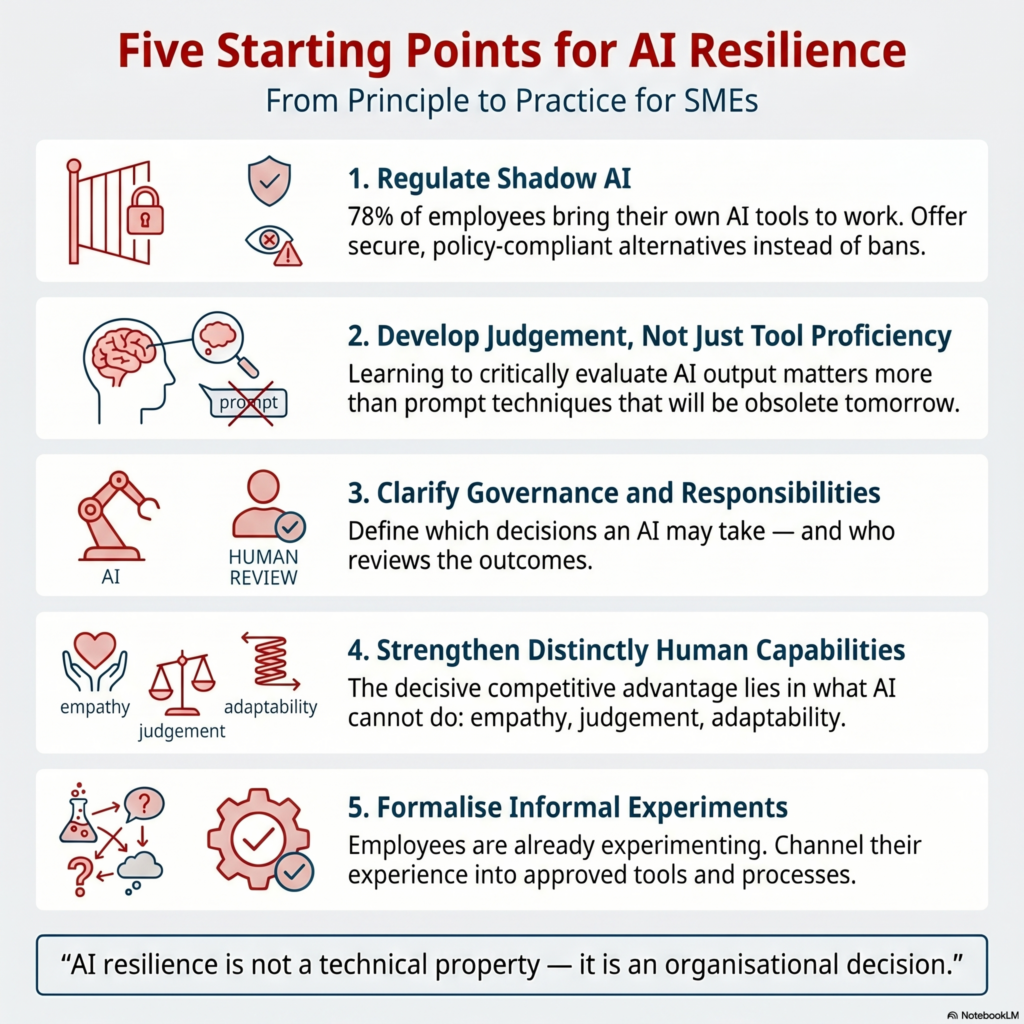
From principle to practice: five starting points for building AI resilience.
1. Regulate shadow AI
In many organisations, employees are already using AI tools through personal accounts. 78 per cent of employees bring their own AI tools to work, often without official approval. (6) This creates security and compliance risks, but it also demonstrates that willingness and interest exist. Reflexive bans merely push usage further into the shadows.
Rather than allowing shadow AI to persist, organisations should offer robust, policy-compliant alternatives. Accompanied by internal guidelines, risky experimentation becomes a shared, secure learning curve. (6)
2. Develop judgement, not just tool proficiency
The half-life of specific prompt techniques is declining as AI models grow increasingly capable. Resilient organisations therefore do not train their employees primarily in tool operation, but in methods and approaches that enable productive collaboration with AI. Beyond this, it is important to strengthen judgement and the ability to adopt a meta-perspective: how does one critically evaluate AI output? How does one systematically check responses for errors? How does one integrate these results safely into genuine business processes?
3. Clarify governance and responsibilities
As AI agents operate with increasing autonomy, the question becomes more pressing: who decides what? Organisations need clear answers about which decisions an AI may take, who reviews the outcomes, and who bears responsibility when something goes wrong.
For important business processes and decisions, a human should always validate the facts, the relevance, and the strategic alignment.
4. Strengthen distinctly human capabilities
AI is increasingly assuming cognitive routine tasks. The human competitive advantage lies in capabilities that machines do not possess: emotional intelligence, strategic thinking, adaptability, and empathy.
The meta-skill par excellence is “learning to learn”: the ability to acquire new knowledge rapidly in the face of permanent change. Organisations that deliberately foster this capability among their employees build a clear advantage.
5. Formalise informal experiments
AI spreads through organisations along two paths: formally, through deliberate strategic decisions taken at leadership level, and informally, through employees who experiment on their own initiative. Informal use generates short-term momentum but rarely leads to the hoped-for productivity gains at an organisational level.
The key lies in capturing informal experimentation and translating it into formal structures: through leadership support, through secure and approved tools, through AI training. Only formal integration into work processes unlocks the full potential.
Building capabilities that become a competitive advantage
The technology will continue to evolve. The next major AI model will arrive, new possibilities will emerge. The capabilities of today will be taken for granted tomorrow.
When considering AI adoption, the question should not be: which tool should we introduce? Instead, consider how the organisation is structured: have we built an organisation that can engage productively with permanent change?
Organisations that invest in AI resilience today are not merely purchasing efficiency gains. They are developing a capability that becomes a long-term competitive advantage — regardless of whichever technological leaps the future may bring.
Would you like to strategically implement AI in your daily business operations?
The question is: What does this look like in your company? Do your employees have the competencies they need for this new work reality? Or are AI integration and competency development currently happening side by side – without systematic connection?
In a no-obligation strategy session, we would be happy to introduce you to the NordAGI approach.
Schedule your complimentary appointment here.
Sources
(1) Menlo Ventures: https://menlovc.com/2024-the-state-of-generative-ai-in-the-enterprise/
(2) S&P Global: https://www.spglobal.com/market-intelligence/en/news-insights/research/generative-ai-shows-rapid-growth-but-yields-mixed-results
(3) BCG: “The Widening AI Value Gap: Build for the Future 2025” (September 2025) https://www.bcg.com/press/30september2025-ai-leaders-outpace-laggards-revenue-growth-cost-savings
(4) AI Study for SMEs 2025, Maximal Digital: https://maximal.digital/studie-ki-im-mittelstand-und-kmu-2025-einblicke-und-impulse-aus-der-ki-studie-2025
(5) World Economic Forum: Future of Jobs Report 2025: https://www.weforum.org/publications/the-future-of-jobs-report-2025/
(6) Microsoft: Work Trend Index 2024 https://news.microsoft.com/annual-wti-2024/ and 2025
AI Governance Starts in the Boardroom | NordAGI
[…] Second: establish visibility. Many organisations do not know which AI systems are already in use. Employees use AI tools through personal accounts, SaaS products contain embedded AI functions that have never been inventoried. The first governance step is therefore a stock take: which AI systems are in use? For what purposes? Who is accountable for the outputs? [AI resilience] […]