


Coinbase is cutting 14% of its workforce. Block is almost halving its headcount. Microsoft is stripping out middle management layers. This looks like an AI-driven redundancy wave. It isn’t. It’s a structural shift that started long before AI entered the picture. In this article, we look at what’s actually happening, why AI is more magnifying glass than root cause, and why the question that matters most for European SMEs has nothing to do with layoffs: How can we achieve more with the same team during a time of acute skills shortages – what Germans call “Fachkräftemangel”, a structural workforce gap that predates AI by decades?
TL;DR:
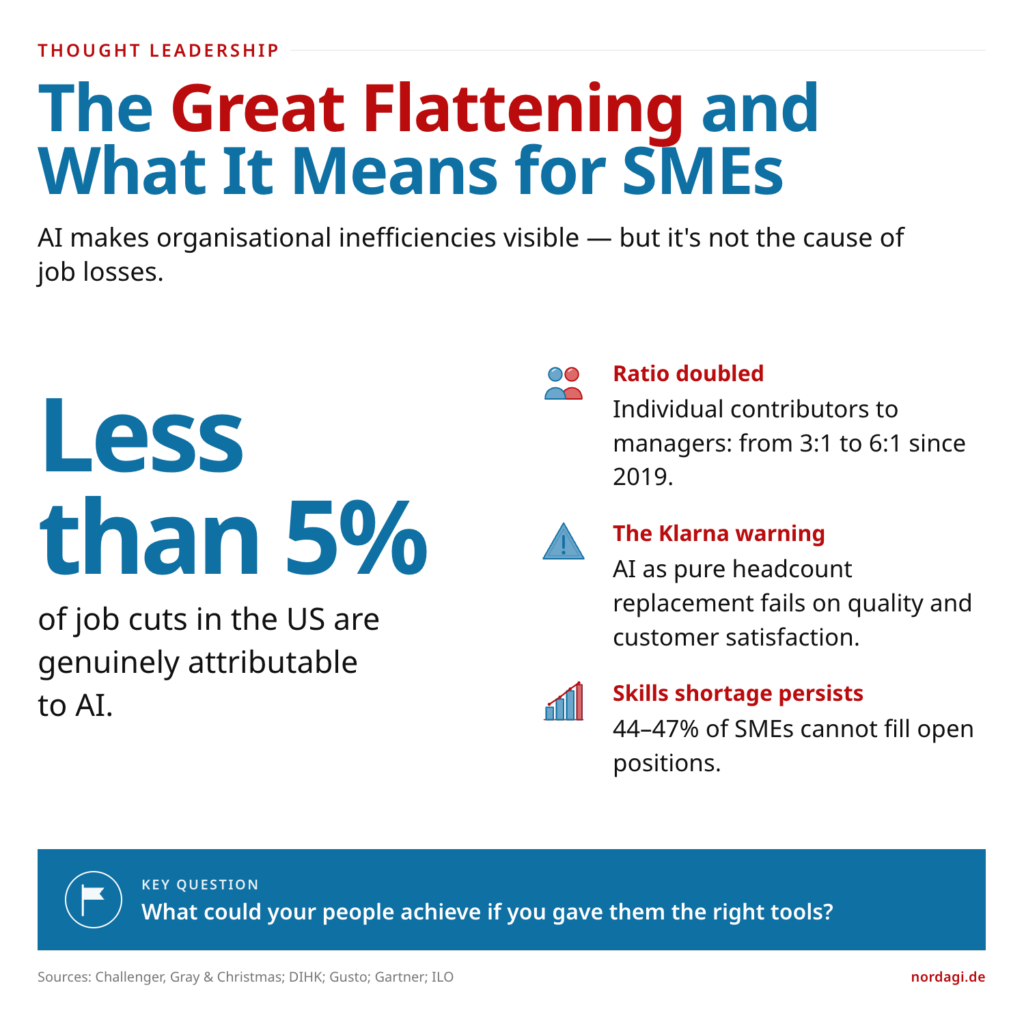
The “Great Flattening” is a measurable trend: organisations are stripping out management layers that coordinate rather than contribute. As a result, the ratio of specialist staff to managers has doubled since 2019. AI is a driver, but not the primary force: statistics indicate that fewer than 5% of US job cuts are genuinely AI-driven. It appears that companies are using AI as a convenient label for restructuring that would have happened anyway. SMEs and family businesses face a fundamentally different question. Not “Whom do we cut?” but “What could our people achieve with the right tools - and that includes AI?”
When organisations question their structures – and not just because of AI
In early May 2026, Coinbase CEO Brian Armstrong published an open letter to staff. The message was blunt: 14% of the workforce – roughly 700 people – would go. The goal, in his words, was to rebuild the company as an “intelligence”, with people at the helm to steer it. [1]
Read past the headline, and the letter contains a remarkable organisational thesis.
Armstrong sets out three objectives:
- Cap the hierarchy at five levels below CEO.
- Every leader becomes an individual contributor – someone who delivers substantive specialist work alongside their leadership role, not just coordinates what others produce.
- The company experiments with “AI-native pods” – teams so small that one person, supported by AI, covers the roles of engineer, designer and product manager. [1]
Coinbase wasn’t first. Weeks earlier, Jack Dorsey at Block (formerly Square) had already published a similar letter, but far more radical. Block is cutting from over 10,000 to under 6,000. Dorsey’s reasoning: AI-powered tools now let smaller, flatter teams work in ways that change what it means to build and run a company. [2]
Coinbase and Block are no isolated examples. The pattern keeps repeating:
- Microsoft stripped out middle management layers in 2025, deliberately widening the span of control per manager. [3]
- Amazon’s Andy Jassy mandated every division to increase the ratio of individual contributors to managers by at least 15%. [4]
- Meta has pursued systematic “flattening” since 2023 under its “Year of Efficiency” banner – reportedly reaching 50 employees per manager in its new Applied Engineering division. [5]
- Shopify’s Tobi Lütke introduced a rule: teams must prove AI cannot do a task before they’re allowed to create a new role. [6]
Every one of these decisions has an AI dimension. The question remains: how fundamental is the role of AI in reality?
What do the numbers reveal? Or is this all just AI-washing?
The consultancy Challenger, Gray & Christmas has tracked AI-attributed redundancies since 2023. In 2025, roughly 55,000 US job cuts were explicitly blamed on AI, with a cumulative total since 2023 of almost 100,000. [7]
This sounds significant. But context matters. Those AI-attributed cuts represent fewer than 5% of all US redundancies in the same period.
The US economy shed over 1.2 million jobs in 2025 alone – the highest since the COVID-19 pandemic. The dominant reasons: restructuring, shifting markets, site closures, expiring contracts. [7]
So, is AI being used as a convenient narrative? Consider: a company cutting jobs over “declining margins” signals trouble. One cutting jobs because of “AI” signals progress. Same outcome, but better optics.
The headcount data supports this reading. Meta’s 10% workforce reduction looked like AI-driven restructuring. However, it brought the company back to its 2021 headcount. Microsoft, even after planned 7% cuts, would still employ 47% more people than before the pandemic. Net US tech employment grew from 8.7 million (2020) to 9.6 million (2023) and has held steady since. [8] Neither growth nor apocalypse. The likelier story may be: pandemic overhiring is being corrected, and sometimes wrapped in an AI narrative that plays better on earnings calls.
Andy Challenger, CRO at Challenger, Gray & Christmas, highlights the tension at Amazon: CEO Jassy told investors in October that the cuts had “nothing to do with AI”. Months earlier, he’d told employees that AI would mean the company needed “fewer people” for certain tasks. [9] Both can be true. But the flexibility of the narrative is telling.
We’ve been here before – why didn’t this start with AI?
This isn’t the first restructuring wave. It won’t be the last. The COVID-19 pandemic offers a useful precedent for how disruptions expose organisational bloat.
During the pandemic, tech companies hired aggressively. Demand for digital services surged. Google, Meta, Amazon, and Salesforce roughly doubled their headcount between 2019 and 2022. [10]
When demand normalised again, an uncomfortable question surfaced: which of these new roles actually contribute to value creation? And which just coordinate the output of others? The answer arrived as the largest tech redundancy wave since the dot-com crash. In 2023 alone, over 260,000 tech workers lost their jobs worldwide. [10]
The cuts fell disproportionately on middle management. According to Live Data Technologies, 29% of all 2024 redundancies hit middle managers – up from a steady 20% between 2018 and 2022. [11] Gartner forecasts that one in five companies will eliminate more than half their middle management positions by the end of 2026. [12]
This trend is measurable and it predates AI. Gusto, a US payroll provider serving over 300,000 small and medium-sized businesses, analysed 8,500 companies and found the ratio of individual contributors to managers nearly doubled between 2019 and 2025, from roughly 3:1 to almost 6:1. [13] Most of it happened through natural attrition: a manager left, the role wasn’t refilled, someone else absorbed the remit.
The phenomenon now has a name: “The Great Flattening”. AI is accelerating it. But the underlying question – does this layer of hierarchy create value or just coordinate? – is older than any large language model.
Why does AI drag inefficiencies into the bright daylight?
The answer isn’t about the technology. It’s about what the technology reveals.
For decades, organisations built layers whose primary function was coordination: passing information upwards, aggregating data, writing reports, aligning decisions across departments, translating specialist knowledge for non-specialists. These functions were necessary. There was no practical alternative.
AI changes the equation. An employee working with AI can access knowledge that previously required hierarchical mediation. They can produce reports, analyse data and draft documents directly. Not perfectly – but well enough to make a purely coordinating role difficult to justify.
AI doesn’t replace jobs wholesale. It reveals where the real contribution lies. Roles that deliver substantive work become more productive. Roles that solely aggregate others’ output get displaced.
Armstrong’s demand for “player-coaches” rather than “pure managers” at Coinbase captures this precisely. The goal isn’t to abolish leadership. It’s to ensure leaders also contribute specialist work, not just oversee.
But there’s a counterargument worth taking seriously. Strip out management layers too fast, and you lose institutional knowledge that no database holds. Mentoring, relationship-building, cultural transmission – these appear in no job description and no AI can replicate them. The real question isn’t whether coordination happens. It’s what else gets delivered alongside it.
How are new competitors reshaping the field?
Until recently, competitors faced similar structural challenges. Inefficiencies existed, but they were distributed roughly evenly.
AI is changing that. To grasp the shift, think of the “Iron Triangle” of quality, speed, and cost – a well-established concept in project management. The conventional wisdom: pick two. Prioritise quality? Accept higher costs or longer timelines. Want speed? Compromise on quality or cost.
Three developments are challenging this paradigm.
Single-founder startups on the rise: Solo-founded startups in the US grew from 23.7% of new ventures in 2019 to 36.3% by mid-2025. [14] This is no longer a fringe phenomenon. Solo founders use AI to produce output that would have required five to ten people a few years ago. Take Maor Shlomo, a 31-year-old Israeli developer who built Base44 as a side project – an AI platform letting non-programmers create apps via text input. Six months after launch: 250,000 users, profitable from day one. Wix bought it for 80 million dollars. [14] Extreme? Yes. But it shows how fast the landscape can move.
Globalisation, redefined: Local presence and established supplier networks used to be durable advantages. That assumption is weakening. And it’s not always China. In the US, SendCutSend showed how a startup can reinvent manufacturing services. Two software engineers, frustrated by the lack of accessible industrial fabrication, now deliver laser-cut metal parts within 48 hours. No minimum orders, transparent pricing, fully online. [15] Meanwhile, complex 3D-printed metal components arrive from China within days, often at a fraction of local cost. The common thread: digital platforms, automated production and global access are creating new business models and lowering the barriers for new entrants.
Speed as a differentiator: When five people with AI deliver in four weeks what fifty people need three months for, the Iron Triangle shifts. The trade-off between quality, speed, and cost becomes less binding.
Where these three trends converge, something new emerges: technology-enabled founders, scaling through global supply chains, bringing products and services to market at a pace incumbents struggle to match. Each trend alone would be manageable. Together, they compound.
None of this means SMEs face imminent displacement by solopreneurs. But the old equilibrium – where everyone was roughly equally inefficient – is challenged and may lose its balance.
What happens when you overplay the hand? The Klarna warning.
Leaner organisations sound appealing. But there’s a cautionary tale worth examining.
Between 2022 and 2024, Klarna cut roughly 700 positions and replaced them with an AI assistant built in cooperation with OpenAI. CEO Sebastian Siemiatkowski celebrated publicly: in its first month, the AI handled 2.3 million customer service conversations, slashed handling time from 11 minutes to under 2, and cut repeat enquiries by 25%. [16]
On paper: a triumph. Markets loved it. Projected savings: 40 million dollars per year.
Then came the problems. Customer satisfaction dropped on complex enquiries. Emotional complaints and multistep issues overwhelmed the system. Engineers were pulled from their actual work to cover when the AI failed. [16]
By mid-2025, Siemiatkowski acknowledged publicly: “Cost was too dominant an evaluation factor. The result was lower quality.” [17] Klarna started rehiring human agents – under a new flexible model, similar to Uber’s approach. The workforce, which had shrunk from 5,500 to 3,400, is growing again. [17]
The lessons are clear. First: “AI replaces people” is a crude formula that will break down when confronted with reality. AI handles routine tasks well. It handles nuance, empathy and contextual judgement poorly – exactly what complex customer interactions demand.
Second: short-term savings from AI substitution can be outweighed by long-term quality erosion and reputational damage. Klarna saved 40 million dollars. The reputational cost proved higher.
Third: the right model is hybrid. Not people or AI. People with AI. Routine and scale for the machine. Judgement and relationships for the human.
What can SMEs and family businesses take from this?
Coinbase, Block, Meta, Microsoft, Klarna – the link to a 150-person manufacturer or a 300-person automotive supplier isn’t obvious. These are tech companies with thousands of employees, deep capital reserves and a fundamentally different organisational culture.
Yet, the core question is the same: which roles create value, and which only coordinate?
The difference lies in the starting position. Tech corporations ask, “Whom can we let go?” SMEs and family businesses more often face the opposite: “Where do we find the people we need?”
The data is stark. In Germany, where the skills shortage is structural rather than cyclical:
- 44% of companies with 20 to 199 employees and 47% of those with 200-999 report difficulty filling positions (DIHK Skills Shortage Report 2025/2026). [18]
- Skills shortages have been the top challenge for SMEs five years running – roughly 40% are affected, even in a weak economy (Zukunftspanel Mittelstand). [19]
- By 2036, around 12 million people will leave the German labour market as baby boomers retire. Far fewer are entering. [20]
- The recent slight easing – the ifo Institute reported in early 2026 that “only” 22.7% of firms were affected – is cyclical, not structural. It will reverse when the economy picks up, on a weaker demographic base. [20]
While the German data is particularly stark, similar patterns of demographic pressure and skills gaps are emerging across much of Europe.
How do you grow when you can’t hire?
This is where the “Great Flattening” takes on a different meaning entirely. For SMEs, the issue isn’t redundancy. It’s how to achieve more with the same team – or even a shrinking one.
Not “AI for everything”. Not “wait and see”. An approach that enables people to do more and relieves them of routine, rather than replacing them.
In practice: an experienced design engineer who spends two hours a day on documentation can redirect that time to higher-value engineering work – if an AI system drafts the documentation. The draft won’t be perfect. But reviewing and approving in ten minutes beats creating from scratch in two hours.
A sales director who waited for a week for her department’s quotation analysis can run it in real time, without anyone aggregating figures for her.
A managing director can get a live view of production capacity because the data no longer needs to pass through human intermediaries.
In none of these cases does the person become redundant. They’re freed for higher-value work. And the organisation gains capacity without hiring people who aren’t available anyway. The ILO confirms this globally: only 5% of jobs in developed economies face genuine automation risk. 13% stand to benefit from AI augmentation. People become more productive, not unemployed. [21]
History backs this up. In 1865, the economist William Stanley Jevons described a paradox: when a resource gets dramatically cheaper, we don’t use less of it. We find countless new uses. [22] After the first electronic spreadsheet launched in 1979, accountants were predicted to become obsolete. Instead, their numbers quadrupled over 40 years. Lower cost per task created more demand, not less.
The same pattern is emerging with AI. Journalist Clive Thompson interviewed over 70 US programmers and found a telling shift: developers code less and think more. “A coder is now more like an architect than a construction worker.” [22] Jevons’ Paradox in action: as AI cuts the cost of software development, firms that could never afford a development team can suddenly commission bespoke software. Demand grows.
For SMEs, the question isn’t whether AI will take over existing tasks. It’s what new possibilities open up when those tasks cost less time and fewer resources. The engineer who gains two hours a day doesn’t work less. They work on different things – including things there was never time for before.
That’s the real relevance of the “Great Flattening” for SMEs. Not “Whom do we cut?” but “What could our people achieve with the right tools?”
Our experience of working with AI
We’ve seen first-hand how AI can make a small team remarkably effective. We work with AI systems daily – using them as sparring partners and productivity levers, not as substitutes for human thinking.
Our conclusion is simple: AI multiplies existing competence. Bring expertise and use AI as a tool, and you’ll see disproportionate productivity gains. Bring no expertise, and you’ll get generic output. AI amplifies what’s already there. Competence on one side. Incompetence equally.
Three questions for SME leaders
Rather than a checklist, three prompts for reflection.
Which roles in your organisation create value directly, and which are mainly coordinating? No judgement implied – coordination matters. But an honest stock take helps. Where you find positions that primarily relay information, compile reports or align decisions between departments, ask whether AI tools could handle part of that coordination. Not to eliminate the role, but to free the person for more substantive work.
Where are tasks left undone because you lack the capacity? Every SME has a list of projects that “really should happen” but don’t, for lack of people. That’s where organic growth with AI support starts: not in reducing existing tasks, but in unlocking new ones with the existing team. And an uncomfortable follow-up: which current tasks exist only out of tradition and no longer add value? In our article on data quality, we drew a distinction between “faster” and “further”. Using AI to accelerate an existing process makes you faster. Using AI to question whether the process still makes sense gets you further. [Data Quality and AI]
If you had five more people, what would they work on? Answer instinctively. That gut response often reveals more than any process analysis. It shows where you see growth potential and which capacity gaps stand in the way. AI won’t replace those five hypothetical people. But it can give your existing team the tools to close part of the gap.
In conclusion
The restructuring at Coinbase, Block, Microsoft, and dozens of others is real. Flattening hierarchies is a measurable trend that predated AI and is now accelerating. New competitors – technology-enabled solo founders, global supply chains, speed as a differentiator – are reshaping the field.
But the conclusion for European SMEs is fundamentally different from Silicon Valley’s.
SMEs rarely have too many people. They usually have too few. The question isn’t “Whom do we replace with AI?” It’s “How do we enable the people we have to achieve more?” Treating AI solely as a headcount tool risks repeating Klarna’s mistake: short-term savings, long-term quality erosion.
Treating AI as a lever for the existing team creates something that sounds almost utopian in today’s labour market: growth, without needing to find people who don’t exist.
Sources
[1] Brian Armstrong, open letter to Coinbase employees, 5 May 2026. Fortune. See also Fast Company and Yahoo Finance.
[2] Jack Dorsey, internal letter to Block employees, February 2026. Original post on X. Reported by Fortune and CNN.
[3] Microsoft dismantles middle management layers and increases “span of control” (2025). Axios.
[4] Amazon CEO Andy Jassy, memo to employees (2025): every division to increase the ratio of individual contributors to managers by at least 15%. CNBC.
[5] Fortune: “Coinbase didn’t just lay off 14% of its staff due to AI” (May 2026). Meta ratio based on reporting on the new Applied Engineering division. Fortune.
[6] Tobi Lütke, memo to Shopify employees, April 2025. Published on social media. Reporting: TechCrunch, Fortune.
[7] Challenger, Gray & Christmas, year-end report 2025. Challenger Report. See also CNBC and Gizmodo.
[8] US technology employment: CompTIA / Bureau of Labor Statistics. Meta and Microsoft headcount comparisons based on SEC filings. Gizmodo.
[9] Challenger, Gray & Christmas, commentary on Amazon redundancies (January 2026). Challenger Report November 2025.
[10] Crunchbase Tech Layoffs Tracker. 2022: approx. 93,000; 2023: approx. 260,000 redundancies. Statista.
[11] Live Data Technologies, cited in CNBC. Middle managers accounted for 29% of all redundancies in 2024, up from approximately 20% in the period 2018-2022. CNBC.
[12] Gartner: forecast that one in five organisations will eliminate more than half of its middle management positions by the end of 2026. Cited in Fortune.
[13] Gusto, a US payroll provider serving over 300,000 small and medium-sized businesses. Analysis of 8,500 companies. Gusto Insights. Reported in Axios.
[14] Base44: TechCrunch, Inc. Magazine, Wix press release.
[15] SendCutSend: on-demand manufacturing. Founded 2018 in Reno, Nevada. sendcutsend.com.
[16] Klarna AI performance and reversal. Fortune, Entrepreneur.
[17] Klarna CEO quote and rehiring. Bloomberg, LaSoft Blog, MLQ.ai.
[18] DIHK Skills Shortage Report 2025/2026. PDF download. Overview.
[19] IfM Bonn / DATEV Magazin: “Zukunftspanel Mittelstand 2025” (January 2026). ifm-bonn.org.
[20] Demographic data: Federal Statistical Office (Statistisches Bundesamt), population projection. ifo Institute: business survey January 2026. ifo.de.
[21] ILO: “Generative AI and Jobs – A Global Analysis.” ilo.org. Only 5% automation risk, 13% augmentation potential in developed economies.
[22] Jevons Paradox and the accountancy example: Eldar Maksymov, Arizona State University. Programmer interviews: Clive Thompson, reporting on 70+ interviews with US programmers.
This article is a contribution from the NordAGI editorial team. It is based on publicly available sources and our own practical experience. The assessments and conclusions reflect our analytical perspective, not absolute certainties.
Would you like to strategically implement AI in your daily business operations?
The question is: What does this look like in your company? Do your employees have the competencies they need for this new work reality? Or are AI integration and competency development currently happening side by side – without systematic connection?
In a no-obligation strategy session, we would be happy to introduce you to the NordAGI approach.