



This post is part of our series “AI Workflows for Practice” – insights into short, immediately actionable workflows that show how we’ve integrated AI into our daily work as a team.
Everyone Knows Speech-to-Text. Now What? Converting speech to text – in 2026, that’s not rocket science anymore. Dozens of apps and tools do it reliably, quickly, and often for free. The problem isn’t transcription. The question is: What happens next?
A treasure trove of information hides in a text file that’s often just as unstructured as the original conversation. A transcript isn’t a summary. A recording isn’t meeting minutes. And a collection of transcribed voice notes is far from a system.
The real leverage happens elsewhere: When AI doesn’t just transcribe, but understands. When it doesn’t just listen, but thinks along. When it evolves from a tool to a full-fledged team member.
What We Mean by "Team Member"
A good team member knows what the rest of the team is working on. They know the context. They remember previous conversations. They can make connections that others miss and contribute ideas.
AI can do this – if you let it. But for that, it needs context. It needs to “be there” for the conversations the team has. It needs to know the thoughts that individual team members have. And it needs a way to structure and store this knowledge.
The workflow we describe here – one we use in our own company – is exactly that: A system through which AI gradually gains more context, and can therefore support us better and better.
The problem: Most valuable conversations and thoughts happen where traditional forms of documentation are extremely impractical. Ideas emerge – and fall through the cracks because they’re not captured anywhere. AI has no access to this context because it simply doesn’t exist.
The Foundation: Capturing Conversations and Thoughts
Everything starts with AI being able to “listen in.” That sounds trivial, but it isn’t.
Our brain is excellent at developing creative ideas, solving problems, and recognizing connections. But it’s remarkably bad at reliably remembering things. That’s exactly why concepts like Getting Things Done (GTD) or Building a Second Brain exist – methods designed to relieve our brain from remembering, so it can focus on what it does best: thinking.
The problem: Most valuable conversations and thoughts happen where traditional forms of documentation are extremely impractical. Ideas emerge – and fall through the cracks because they’re not captured anywhere. AI has no access to this context because it simply doesn’t exist.
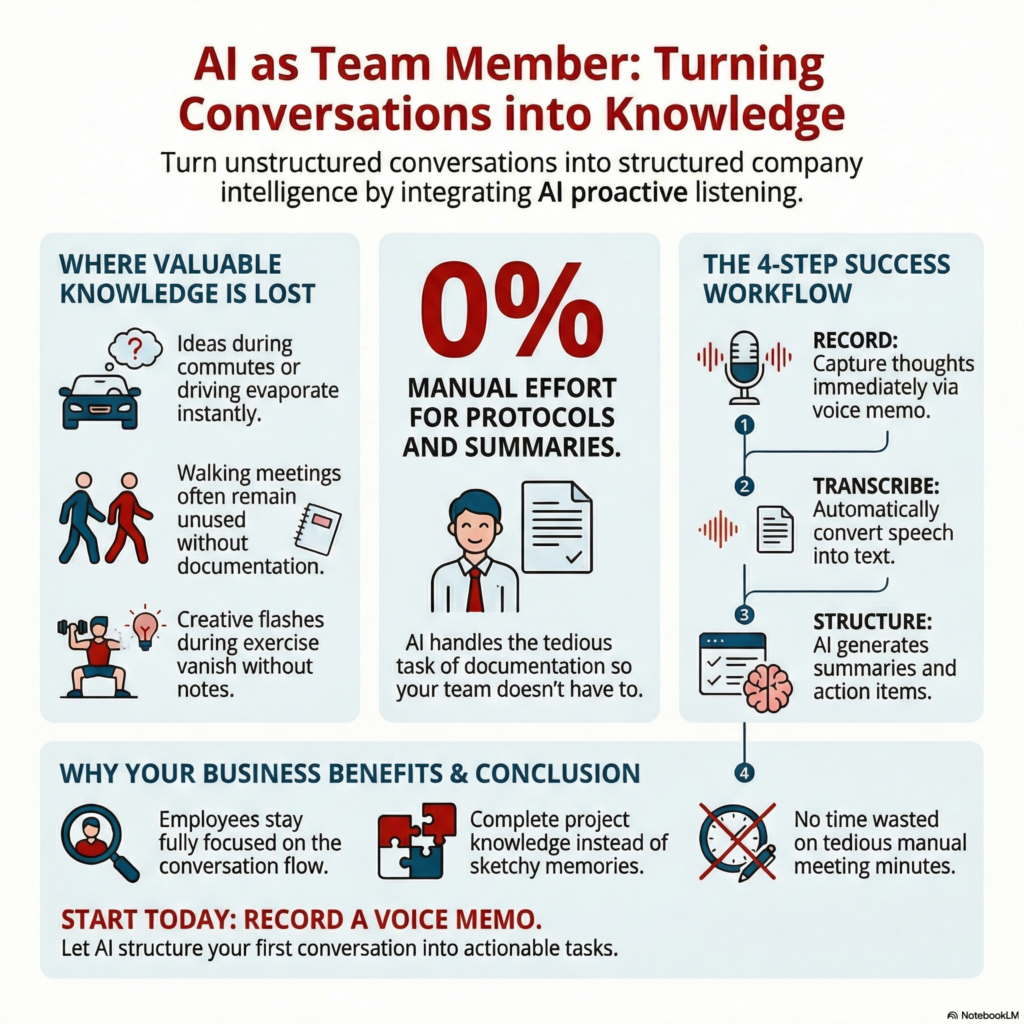
Walking Meetings: Several team members go for a walk together, discussing projects, strategy, open items. Everyone’s in the flow. Many good and new ideas are discussed. Documentation falls short – who wants to type on their smartphone or take notes on paper while walking?
In the Car: The 30-minute commute is often the only undisturbed thinking time of the day. Ideas come, but typing is dangerous and impractical. So you try to keep the thoughts in your head – and lose them at the latest with the next phone call.
Between Meetings: Those five minutes walking from one meeting back to your desk? Perfect for capturing insights – if you didn’t have to struggle with your phone. The fresh insights from the meeting fade while you work through emails.
During Solo Walks or Jogging: Movement gets thoughts flowing. But who jogs with a notebook? The best ideas come exactly when documentation is most impractical.
What we’ve found to be a practical solution: Record instead of type. Smartphone voice memo, voice recorder, or any other recording app. Hands-free via voice command even works while driving. Then the ideas are at least out of your head – but not yet in a system where they can be processed further. This is where AI comes in.
From Transcript to Structure: This Is Where AI Comes In
The transcript is the raw material. AI turns it into something useful:
Step 1: Record. Capture the conversation or thoughts as a voice note. Your brain is relieved – the thought is secured.
Step 2: Transcribe. The recording is automatically converted to text. Many apps do this directly, or you use a separate service.
Step 3: Let AI analyze. The transcript goes into Claude, ChatGPT, or a comparable tool – along with a prompt that provides the necessary structure: Create a summary, identify discussed topics, extract to-dos, collect ideas for later.
Step 4: Use and feed back the results. The to-dos go into the task system, the ideas into your collection, the summary into your documentation system. The crucial additional step: The structured results also flow back into the AI’s project knowledge. This means it has more context for the next conversation – and can actually think and work as a full-fledged team member. This creates a cycle: The more AI “listens in,” the better it understands what the team is working on.
The Core Benefit: Staying in Flow
The decisive factor isn’t the technology or which app is used, but what it enables: You stay in your train of thought. No interrupting for notes, no typing around, no “wait a moment, I need to write that down.” No: “How did you put that?”
For walking meetings, this means: All participants are fully present. No one is relegated to note-taker. The conversation flows naturally – and AI documents in the background.
For solo notes, this means: The thought is captured before it fades. Without the cognitive load of having to keep it in your head.
And another psychologically important aspect: Writing minutes isn’t fun. Nobody looks forward to listening to a 30-minute meeting again and extracting the key points. That means: investing another 30 minutes – or more – to reconstruct the conversation and extract the core messages. Often it simply doesn’t get done, and valuable insights are lost.
AI removes this mental burden. Documentation happens automatically, without extra work. Nobody has to do “homework” after the meeting. This lowers the barrier enormously – and leads to documentation actually happening, instead of just good intentions.
Two Perspectives: Personal and Team
The workflow works on two levels:
Personal Productivity: Capturing your own thoughts, ideas, observations. AI as a personal assistant that remembers what’s on your mind. Recording several short notes throughout the day, which get collectively analyzed in the evening – and you have your daily overview.
Team Collaboration: Documenting conversations between team members. Walking meetings, one-on-ones, spontaneous check-ins. AI as a shared memory that captures what was discussed – without anyone having to take minutes.
In both cases: The more AI “listens in,” the more context it has. And the more context it has, the better it can support you.
A Culture of Open Exchange
For this workflow to work, it takes more than technology. It requires a culture where no one feels inhibited speaking openly – even when the recording is running.
Important to understand: AI doesn’t reproduce a 1:1 transcript, but the essence of the thoughts. It’s not about who said what word for word, but which topics were discussed, which decisions were made, which tasks emerged.
This creates space for genuine exchange. Different opinions can be voiced without anyone having to fear being “pinned down” later on a spontaneous formulation. This diversity of perspectives is precisely what’s valuable: Companies benefit when different viewpoints flow into decision-making. AI can capture and structure these different perspectives – but only if they’re actually expressed.
Transparency is crucial: Everyone knows that recording is happening. Everyone understands the purpose. And anyone who doesn’t want to be recorded at a particular moment says so – that’s respected, no discussion.
Sensitivity around confidential information: Not all conversations are suitable for AI processing. Personnel discussions, confidential client data or strategically sensitive decisions do not belong in this workflow. The rule is simple: if it’s confidential, it shouldn’t be recorded. Important: Even though the AI provides structured summaries rather than verbatim quotes, the responsibility for data protection and confidentiality lies with the team. When in doubt: switch off the recording, have the conversation, and note down the key points manually.
Tips from Practice
Speaker recognition in conversations: Most transcription apps can distinguish speakers once you “train” them. Say “I’m Sebastian” once, then the app recognizes the voice.
Short and often rather than long and rare: Better ten 30-second notes throughout the day than one 15-minute recording in the evening when memories aren’t as precise anymore. The short snippets are closer to the original thought.
Review results: As with any AI use: The extraction is very good, but not perfect. A quick glance before the to-dos go into the system or the key points go into documentation is important.
Feed back results: The structured summaries belong in the AI’s project knowledge. Otherwise, it remains a tool that starts from zero every time. With context, it becomes a team member that remembers and can also act as a sparring partner.
The Strategic Foundation: Reviews
Capturing conversations and thoughts is the first step. A much greater leverage unfolds when you systematically collect the results and bring them together in reviews:
Daily Review: All voice notes of the day in one overview – as the foundation for daily reflection.
Weekly Review: The week in retrospect – what occupied me, what’s open, what patterns emerge?
Monthly and Quarterly Review: This is where it gets strategic. Which topics keep coming up? Which blind spots does AI uncover? What have we overlooked? Which topics are we grinding away at without making real progress?
And with each review, AI gains more context. It better understands what the team is working on. It recognizes patterns. It becomes a team member that doesn’t just listen, but thinks along.
In Part 2 of this mini-series, we show the specific prompts – and how the review workflow turns an AI into a real team member.
Would you like to strategically implement AI in your daily business operations?
The question is: What does this look like in your company? Do your employees have the competencies they need for this new work reality? Or are AI integration and competency development currently happening side by side – without systematic connection?
In a no-obligation strategy session, we would be happy to introduce you to the NordAGI approach.
How AI Becomes a Full-Fledged Team Member Through Reviews
[…] Part 1, we covered capturing conversations and thoughts – the foundation for everything that follows. […]