



AI is not a gradual evolution of existing technology. It is a disruption – and when disruptions take hold, they tend to do so broadly, rapidly, and simultaneously.
Many managing directors of SMEs and family businesses are experiencing AI in the phase just before this breakthrough. Early signals are already visible: individual employees are working more productively thanks to AI, certain processes can be noticeably accelerated. But comprehensive integration into day-to-day business operations is something most organisations have yet to achieve.
Against this backdrop, it is worth examining a remarkable thesis put forward by Eric Schmidt, former CEO of Google and one of the world’s most influential technology investors, during his TED appearance in April 2025: under certain assumptions, AI could drive productivity gains of approximately 30% per year. Economists, according to Schmidt, have no models for a development of this magnitude. It would be without precedent in history.
Could AI drive productivity gains of approximately 30% per year?
Several months have passed since April 2025 – and in the timescales of AI development, that is half an eternity. Models have become significantly more capable since then, AI agents are taking on increasingly complex tasks, and the pace of development tends to confirm Schmidt’s assessment rather than temper it. Should the major breakthrough not already be evident by now?
This assessment comes from someone who has shaped the technology industry for decades. What do his predictions mean in practice for a family business with 150 employees? Between Silicon Valley visions from April 2025 and the present-day reality of a managing director running an SME, there are not only 9,000 kilometres but also fundamentally different operating conditions.
We are convinced that the core messages from Schmidt’s talk are relevant for European SMEs and family businesses. But they need to be translated – from Silicon Valley visions to the level of concrete business decisions in owner-managed companies.
AI-First transformation means shaping change deliberately. It’s not about having perfect solutions. It’s about shaping change with intention, rather than letting it happen by default.
What Schmidt actually says – and what he means
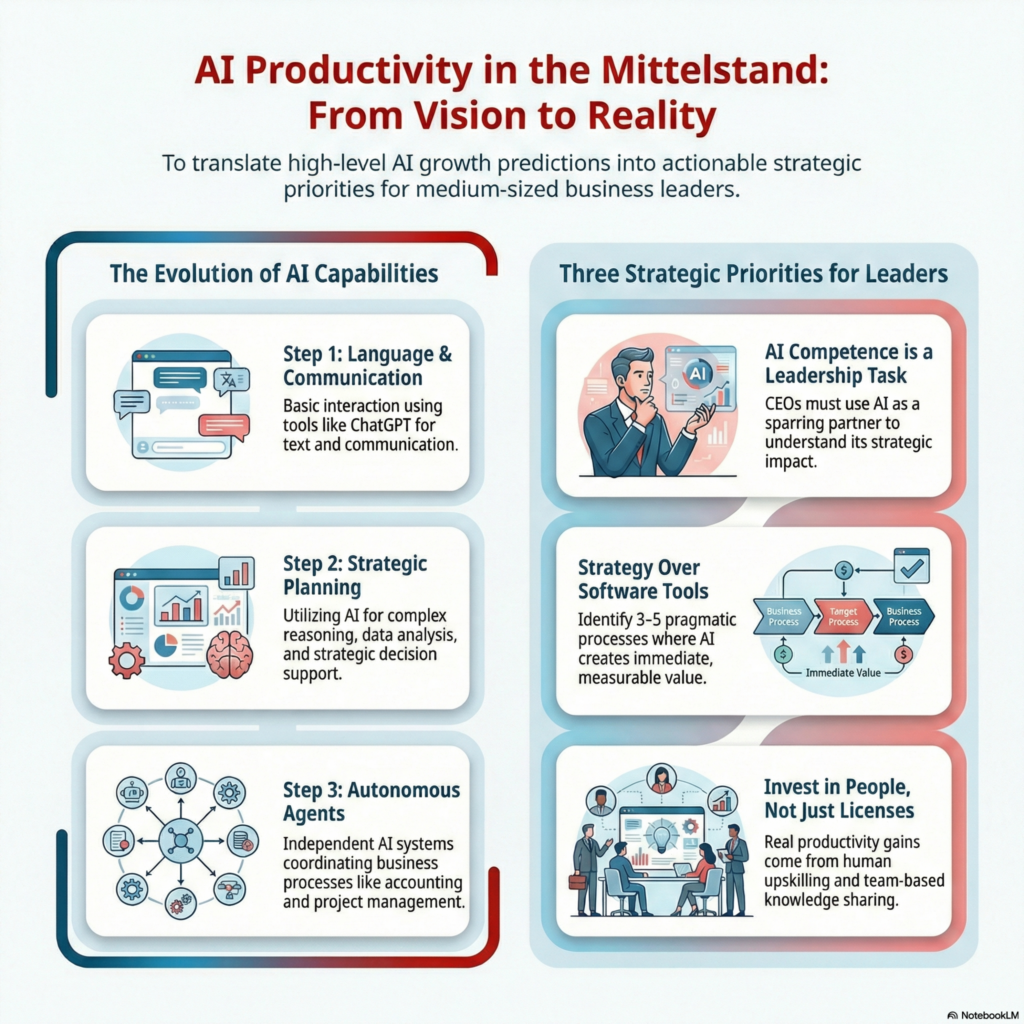
Schmidt describes a development in three stages. First, the language capability of AI systems, as most people came to know it through ChatGPT. Then the ability to plan and think strategically, which current models already demonstrate. And finally, a future in which AI agents independently execute business processes – coordinated, communicating with one another in natural language.
His concrete vision: one agent for accounting, one for project management, one for client communications. All working together, all speaking to each other. Humans steer; agents execute.
This is genuinely no longer science fiction. The technological foundations already exist. The question is not whether, but when and how this development reaches mainstream adoption. And this is precisely where it becomes relevant for SMEs.
What this means for your business
For business leaders in SMEs and family businesses, three central impulses can be drawn from Schmidt’s analysis:
- First – AI fundamentally changes the productivity equation: Schmidt describes a world in which organisations can achieve significantly more with AI support without proportionally expanding their workforce. For SMEs that have struggled with talent shortages for years, this is a strategically relevant prospect. Not as a replacement for skilled employees, but as an opportunity to deploy existing teams more effectively and to achieve growth even in a constrained labour market.
- Second – The speed of development exceeds our intuition: Schmidt uses the image of a marathon: anyone who takes a step every day forgets after a year just how far they have come. Development is not linear. Organisations that engage with AI systematically today are building competencies that compound over time. This does not mean you need to overhaul your entire business tomorrow. But it does mean that conscious engagement with the topic is more productive than waiting – if only to build the readiness and understanding for AI within the organisation. When the breakthrough arrives, the businesses that already possess AI readiness will be best positioned to benefit.
- Third – The decisive competitive advantage lies not in the technology itself, which is available to everyone, but in the systematic development of AI competency: Schmidt himself uses AI systems extensively across different use cases. He describes, for instance, how deep research functions produce analyses in 15 minutes that previously required days. Translated to SMEs, this means: competitive advantage does not come from purchasing a particular tool, but from the organisation’s ability to deploy different AI tools simultaneously, systematically, and competently.
Our assessment: A bold vision, but the path requires strategy
We share Schmidt’s central thesis and experience it daily ourselves. AI is changing the way businesses operate, fundamentally. What we view critically, however, is the implicit assumption that rapid adoption or isolated implementations automatically lead to good results.
Schmidt says, in essence: those who fail to use this technology will become irrelevant compared to their competitors. There is something to that. But it overlooks a decisive factor that we observe in our consulting practice: the technology works. The challenge lies in the organisational change that businesses must undertake in order to truly unlock the leverage that AI systems can provide.
Introducing an AI tool takes days. Developing an organisation to the point where it can use these AI tools productively takes months. And this is precisely the difference between businesses that achieve genuine productivity gains with AI and those that revert to old working methods once the initial enthusiasm fades.
A strategic approach is therefore not optional but a prerequisite for turning isolated experiments into actual, sustainable AI implementation. Without a strategic framework, organisations encounter the same pattern time and again: individual employees experiment with ChatGPT or similar tools, achieve isolated successes – but the results remain siloed and fail to scale. An AI strategy creates the framework that transforms individual experiments into a systematic transformation process.
In our 5-phase model of AI transformation, we describe this journey from unplanned AI usage by individual employees through to AI-supported team processes and semi-autonomous AI agents. The critical point: each phase requires not only different technology but also different organisational prerequisites. And each phase is a change management challenge in its own right.
Perhaps the most significant change concerns the role of employees themselves
From our own practice, we know this: when AI becomes a team member, working methods change dramatically. Employees who previously worked through tasks sequentially and systematically must learn to manage multiple AI systems simultaneously, evaluate outputs, and select the right AI tools for the right tasks. They become coordinators of various AI systems – a role that demands new competencies: critical thinking in assessing AI outputs, the ability to coordinate multiple AI-supported processes in parallel, and above all the responsibility to verify results and make the final decision. Regardless of how capable AI systems become: the human remains the ultimate decision-maker.
This upskilling goes far beyond IT training. It represents a change in the nature of work itself – and is therefore a classic change management task that must be understood and championed by leadership.
What we specifically recommend
For business leaders looking to assess Schmidt’s impulses and translate them into action, we see three priorities.
First – Start with the leadership team: AI competency is a leadership responsibility. If you, as a managing director, do not understand what AI means for your industry, your business, and your processes, you cannot make informed strategic decisions. This does not mean you need to learn programming. But it means more than occasionally having an email drafted for you. Use AI as a sparring partner for strategic questions, have it produce analyses and scenarios, test how AI can support your own decision-making processes. Only when you experience first-hand what AI can deliver – and where its limitations lie – can you set the right course for your organisation.
Second – Prioritise developing an AI strategy over investing in AI tools: Identify three to five processes where AI can already create measurable value in your business today. Not the most spectacular, but the most pragmatic: routine tasks, research, documentation, communications. Where the leverage is greatest and implementation comparatively straightforward. An AI strategy ensures that these initial successes are not a matter of chance but the beginning of a systematic path towards AI implementation.
Third – Invest in building competencies, not just software licences: The best AI tool is of little use if your employees do not know how to deploy it effectively. Competency development in the AI space works differently from traditional software training. AI competency does not emerge from a two-day seminar but through experimentation, gathering experience, and above all through exchange within the team. When colleagues share their AI experiences – which tool works for which task, which prompts deliver good results, where pitfalls lie – an informal knowledge pool emerges that is more valuable than any training manual. Create space for this exchange: regular formats in which teams can share their AI working methods, without pressure and without the expectation of perfection. This scales better than most top-down training programmes.
The marathon has begun
Eric Schmidt is right when he says that AI development is a marathon, not a sprint. And he is right when he says that everyone has a reason to use this technology. What he naturally has less sight of from his Silicon Valley perspective of large corporations is the reality of European family businesses: limited resources and the imperative to unlock tangible value for one’s own business rather than chasing a trend.
We are convinced that precisely these qualities – pragmatism, good judgement, long-term thinking – are ideal prerequisites for a successful AI transformation. The change is already here. The question is whether you will shape it.
Would you like to strategically implement AI in your daily business operations?
The question is: What does this look like in your company? Do your employees have the competencies they need for this new work reality? Or are AI integration and competency development currently happening side by side – without systematic connection?
In a no-obligation strategy session, we would be happy to introduce you to the NordAGI approach.
How is AI rewriting the headcount vs value creation equation? | NordAGI
[…] workforce through AI support — Strategy 3 as the entry point, a theme we explore further in AI productivity in SMEs: when will the breakthrough actually arrive?. Then, as positions become vacant due to retirement and cannot be filled because of labour market […]