


Anyone who regularly scrolls through LinkedIn will recognise the pattern: infographics explaining what a large language model is. Carousel posts listing the ten best AI tools for every conceivable task. And in between, the reasons why 80, 90 or more per cent of all AI projects fail.
There is clearly no shortage of information or tools. HuggingFace alone now hosts nearly two million AI models. The number of AI tools on the market has surpassed 22,000, spanning more than 230 categories [1]. The enterprise AI software market has grown to remarkable proportions: anyone searching for a specific AI tool will find not just one, but ten or even a hundred – all sharing the same promise of solving that one particular problem.
What seems paradoxical: despite all of this, AI transformation in SMEs and family businesses remains stalled. This is evidently not due to a lack of access to technology, nor to insufficient AI literacy. We believe it stalls because of a phenomenon that receives surprisingly little attention.
TL;DR:
The central barrier to AI adoption amongst SMEs and family businesses is neither a lack of technology nor a lack of knowledge — it is a lack of imagination.
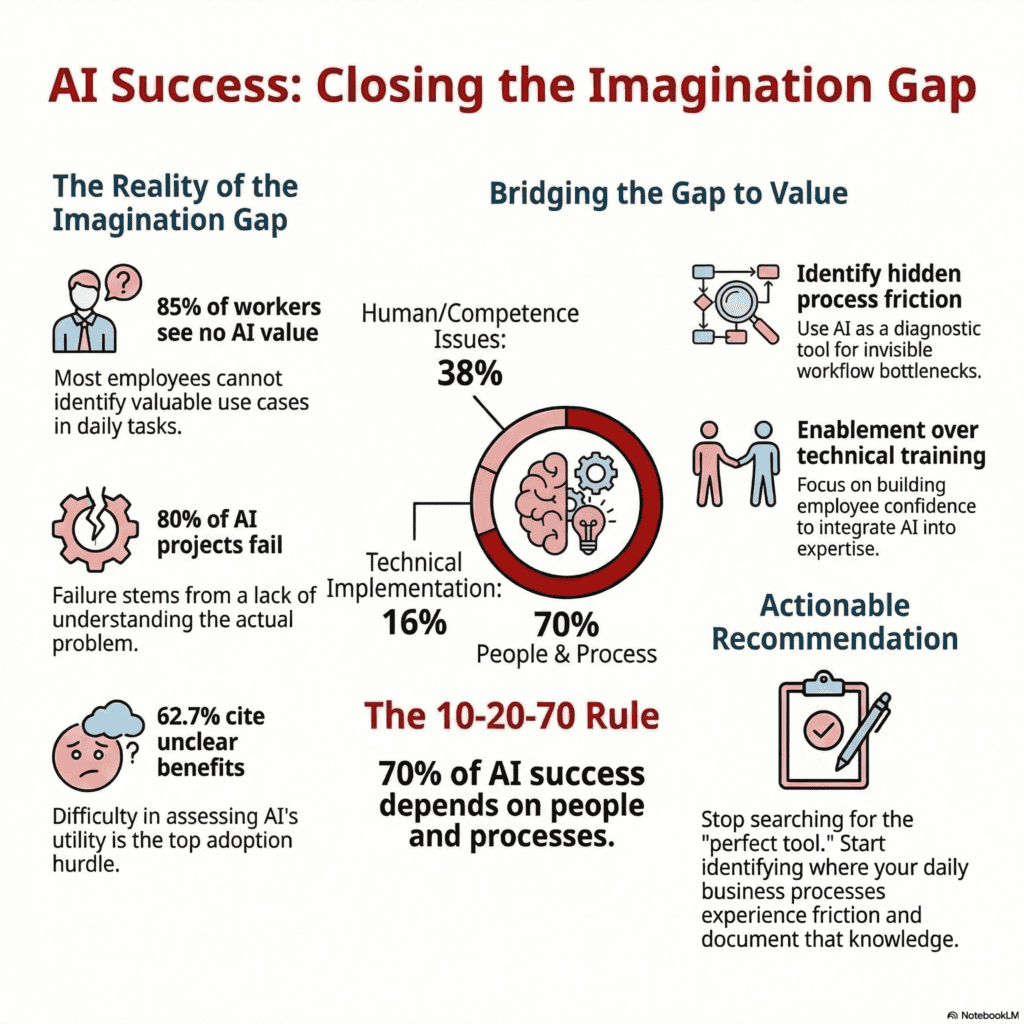
85 per cent of knowledge workers see no value-creating use case for AI in their daily work (Section AI Proficiency Report, 2026). Only five per cent of all organisations generate substantial economic value from AI (BCG, 2025). The cause: companies solve the wrong problems, fail to recognise invisible friction as a bottleneck — or deploy AI on tasks that were unnecessary to begin with.
The solution lies not in more tools, but in three levers: systematically expanding imagination, leveraging existing process knowledge as a strategic advantage, and prioritising enablement over technology.
The real question is not “Which tool?” but “How to use AI?”
A 2025 study by the Royal Bank of Canada and the University of Toronto (Munk School of Global Affairs) coined a term for this phenomenon: the Imagination Gap.
The core thesis: the central barrier to AI adoption is neither a lack of technology nor a shortage of talent and knowledge, but the widespread difficulty organisations face in envisioning where AI could concretely contribute to their business processes [2].
This sounds like an enormous contradiction at first, yet it is ubiquitous in practice. The Section AI Proficiency Report from January 2026 – a survey of 5,000 knowledge workers – brings the challenge into sharp focus: 85 per cent of all employees see no value-adding use case for AI in their daily work [3]. Not because AI tools are lacking. Not because they don’t know how to write a prompt. But simply because they lack the imagination to identify which processes or aspects of their daily work could be efficiently supported or executed with AI [3].
The study puts it this way: the greatest challenge in working with AI is not learning how to operate it, but recognising what it can be used for [3].
The study puts it this way: the greatest challenge in working with AI is not learning how to operate it, but recognising what it can be used for.
Why the gap emerges
The RBC/Munk School study describes several mechanisms that explain where the imagination gap comes from [2].
The first of these mechanisms is the Paralysis of Plenty. AI opens up such a broad field of possibilities that the sheer range of options leads to a degree of inaction – what amounts to decision paralysis. Choosing to select the first concrete use case becomes the bottleneck – not because possibilities are lacking, but because too many are available simultaneously [2].
The second mechanism concerns blind spots – or, to put it more precisely: things one does not even know one does not know. Organisations fail to recognise the explorative and diagnostic potential of AI because, without first-hand AI experience, they simply cannot envision what AI could make possible [2]. Put differently: anyone who has never experienced what a well-configured AI can achieve beyond basic use cases cannot unlock that potential and implement it as a solution.
The third is champion churn: when the person who drove an AI pilot project changes roles or leaves the organisation, their successor often inherits the risk but not always the conviction and enthusiasm for the project [2].
When the Imagination Gap strikes: solving the wrong problems
One might assume that the Imagination Gap manifests primarily as stagnation. Yet it also manifests – and this is perhaps more interesting for the present discussion – as activity and effort in the wrong places: organisations that start with AI but end up addressing the wrong problems.
The RAND Corporation found in 2024 that over 80 per cent of all AI projects fail. The number one cause: a fundamental misunderstanding of which problem was actually meant to be solved [6]. This is the Imagination Gap in action. Not a lack of technical execution, but a lack of problem comprehension – the inability to identify the right problem to solve with AI, namely the problem where AI deployment would actually generate additional value.
In a 2024 study, Gartner predicted that at least 30 per cent of all generative AI projects would be abandoned after the proof of concept – not due to technical failure, but due to unclear business value [7].
In translation and summary, this likely means: these organisations identified a problem, solved it technically, only to discover subsequently that the solution delivered no meaningful economic contribution.
The problem with the “right problem” is the decisive problem
Whether one solves such a problem with AI, with a spreadsheet, or with an abacus is ultimately irrelevant. If solving the problem itself brings no benefit to the organisation, then no tool in the world can generate value from it.
BCG’s “Build for the Future” study from 2025 confirms the broader picture: only five per cent of all organisations generate substantial economic value from AI. Sixty per cent achieve no measurable benefit despite considerable investment [4]. McKinsey’s State of AI Report reaches a similar conclusion: 88 per cent of organisations deploy AI in at least one function, but only six per cent qualify as “high performers” [5].
Our interpretation: the gap between tool access and actual value creation – as demonstrated by the high performers – is enormous. It cannot be explained by technological deficits, but rather by a gap in strategic imagination when it comes to addressing the “right problems” with AI.
Invisible friction: problems that nobody recognises as problems
The Imagination Gap has yet another dimension. It is not only about selecting the “right problems” where AI deployment genuinely adds value. It is also about the challenge of failing to recognise actual problems in the first place – because they have long since been normalised as typical workload. Or in other words: that’s how we’ve always done it.
Research shows that employees spend an average of 1.8 hours per day – 9.3 hours per week – searching for information [8]. That is roughly one-fifth of total working time, bound up in invisible friction. Nobody would place this information search on the agenda as a “problem” – it simply belongs to everyday work. That is precisely why it appears on no list of AI use cases. And that is precisely why it exemplifies the Imagination Gap: a real bottleneck that remains invisible because it has never been questioned as one.
The counterpart to this is what researchers at the University of Leeds describe as “Efficient Inefficiency” [9]: organisations that deploy AI on tasks that were superfluous from the start – thereby merely accelerating idle running rather than eliminating it. This, too, is a consequence of the Imagination Gap. Those who fail to recognise which tasks genuinely create value risk using AI to solve the wrong problems more efficiently whilst still contributing nothing of value.
AI as diagnostic instrument rather than accelerator
The strategically interesting question is surely this: what happens when an organisation deploys AI not merely as a tool for acceleration, but as an instrument for diagnosis?
AI can reveal patterns that remain invisible in day-to-day operations. It can challenge processes that nobody questions any longer because they have always worked that way. It can – to use an analogy – function as an X-ray machine that shows where friction arises in processes, or where energy is not being deployed productively because no substantial value is being generated for the organisation.
And it can do something else: systematically unlock the implicit knowledge held in employees’ minds. In many organisations, the most important processes, decision rules, and accumulated expertise have never been comprehensively documented and examined. They exist as internal expert knowledge – but not as codified knowledge. This represents not only a risk to the organisation, but also a fundamental obstacle to AI deployment: without context, AI can only create value to a limited degree.
Organisations that systematically document their processes and domain knowledge – and AI can serve as an ideal sparring partner in this endeavour – simultaneously lay the foundation for valuable AI use cases.
This requires, however, people who know where to look. And this is precisely where the circle closes.
The solution lies not in “more technology” but in “more imagination”
BCG’s widely cited 10-20-70 principle for successful AI implementation attributes the technology component to 10 per cent algorithms and 20 per cent data and infrastructure. The remaining 70 per cent falls to people and processes [10] – to enabling people, inspiring them, and unlocking their imagination for where AI could genuinely provide helpful support in their daily workflows.
The Imagination Gap does not close through more knowledge about AI tools, nor through better infographics. It closes when organisations systematically address three things.
First: deliberately strengthen imagination. This sounds unusual in the context of technology implementation, yet it is the decisive first step. Organisations need structured formats in which teams examine their own work processes with fresh eyes. The starting question is not “What can AI do?” but rather “Where does friction arise in our operations that we no longer question?”
Second: leverage existing process knowledge as a strategic advantage. In a world where every organisation can access the same AI models, organisational context becomes the differentiating factor [11]. Employees know the workflows, the exceptions, the workarounds, and the recurring bottlenecks. This knowledge is the raw material from which value-adding AI use cases emerge – but only when it is systematically unlocked.
Third: enablement before technology. In a study of over 1,100 professionals, Prosci found that 38 per cent of all challenges in AI adoption are attributable to insufficient user competence – compared with only 16 per cent for technical implementation problems [12]. Enablement does not mean offering training courses on prompting techniques. It means giving employees the confidence to integrate AI as a tool within their own professional expertise – without the fear of being replaced, and with the freedom to experiment.
Asking the right question for strategic AI Implementation
The Imagination Gap is not a technical problem. It is a strategic one. And it affects SMEs and family businesses to a particular degree: 81 per cent of German companies regard AI as the most important future technology [13]. Yet only six per cent deploy it across multiple business areas [14]. The greatest barrier identified by the Institut der deutschen Wirtschaft is not missing technology, but the perceived difficulty of assessing AI’s business value – cited by 62.7 per cent as the most frequent obstacle [14].
That is the Imagination Gap in a single figure.
The encouraging news: SMEs and family businesses bring precisely the prerequisites needed to close this gap. Deep domain knowledge, process orientation, short decision-making paths, and employees who know their business. What is lacking is not AI competence. What is lacking is a systematic approach to connecting existing professional expertise with AI’s possibilities.
Would you like to strategically implement AI in your daily business operations?
The question is not: which AI tool should we buy? The question is: what could AI make possible in our organisation that we have not previously considered possible?
If you would like to answer this question systematically, let’s have a conversation.
In a no-obligation strategy session, we would be happy to introduce you to the NordAGI approach.
Sources:
- [1] Userpilot / Fullview.io, AI Statistics 2025; Originality.AI LinkedIn Content Analysis
- [2] RBC / University of Toronto Munk School of Global Affairs: “Bridging the Imagination Gap: How Canadian Companies Can Become Global Leaders in AI Adoption”, June 2025. https://www.rbc.com/en/thought-leadership/the-growth-project/bridging-the-imagination-gap-how-canadian-companies-can-become-global-leaders-in-ai-adoption/
- [3] Section: AI Proficiency Report, January 2026. https://www.sectionai.com/ai/the-ai-proficiency-report
- [4] BCG: “The Widening AI Value Gap – Build for the Future”, September 2025. https://www.bcg.com/publications/2025/are-you-generating-value-from-ai-the-widening-gap
- [5] McKinsey: “The State of AI in 2025”, 2025. https://www.mckinsey.com/capabilities/quantumblack/our-insights/the-state-of-ai
- [6] RAND Corporation: “The Root Causes of Failure for Artificial Intelligence Projects”, 2024. https://www.rand.org/pubs/research_reports/RRA2680-1.html
- [7] Gartner: Press Release, July 2024. https://www.gartner.com/en/newsroom/press-releases/2024-07-29-gartner-predicts-30-percent-of-generative-ai-projects-will-be-abandoned-after-proof-of-concept-by-end-of-2025
- [8] McKinsey Global Institute: “The Social Economy: Unlocking Value and Productivity Through Social Technologies”, July 2012. https://www.mckinsey.com/industries/technology-media-and-telecommunications/our-insights/the-social-economy
- [9] Mills & Spencer, University of Leeds: “Efficient Inefficiency: Organisational Challenges of Realising Economic Gains from AI”, 2024. https://www.sciencedirect.com/science/article/pii/S0148296324006325
- [10] BCG: AI @ Scale Capabilities. https://www.bcg.com/capabilities/artificial-intelligence
- [11] Harvard Business Review: “When Every Company Can Use the Same AI Models, Context Becomes a Competitive Advantage”, February 2026. https://hbr.org/2026/02/when-every-company-can-use-the-same-ai-models-context-becomes-a-competitive-advantage
- [12] Prosci: “AI Adoption: Driving Change With a People-First Approach”, 2025. https://www.prosci.com/blog/ai-adoption
- [13] Bitkom: “Durchbruch bei Künstlicher Intelligenz”, September 2025. https://www.bitkom.org/Presse/Presseinformation/Durchbruch-Kuenstliche-Intelligenz
- [14] Institut der deutschen Wirtschaft (IW Köln): “Künstliche Intelligenz als Wettbewerbsfaktor”, 2025. https://www.iwkoeln.de/fileadmin/user_upload/Studien/Report/PDF/2025/IW-Report_2025-KI-als-Wettbewerbsfaktor.pdf