



In Part 1, we covered capturing conversations and thoughts – the foundation for everything that follows. This second part shows how AI gains more and more context through systematic reviews, evolving from a tool to a real team member. We’ll also share the prompts we actually use – ready for you to adopt directly.
The Goal: An AI That Knows the Team
Everyone knows speech-to-text. That’s nothing new. The difference lies in what happens next.
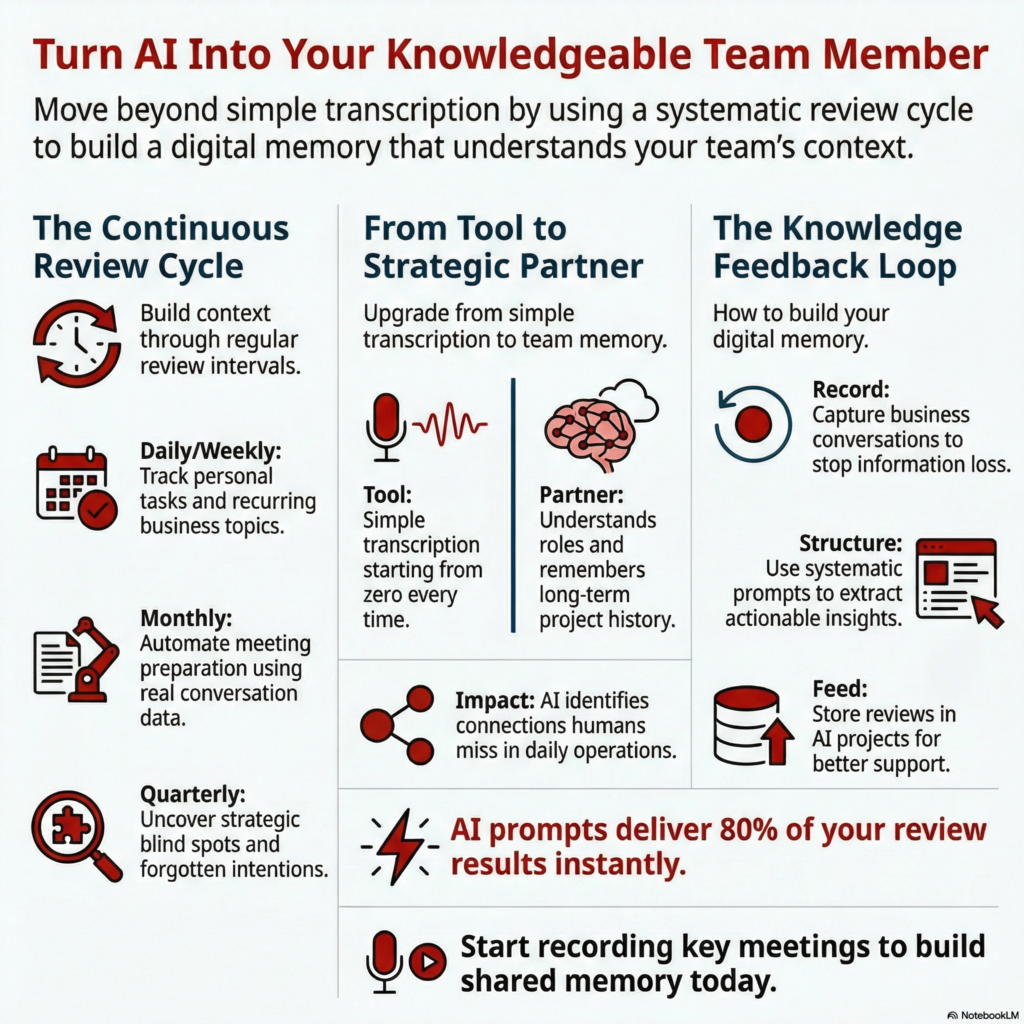
An AI that only transcribes is a tool. Useful, but interchangeable. An AI that knows the team’s context is something different: It knows what’s being worked on. It knows the roles in the team – who’s responsible for what, who brings which expertise. It remembers which topics keep coming up and what was decided. It becomes a team member that remembers and thinks along.
The path there leads through three things: Context, Structure, and Continuity. The context comes from the conversations and notes that are captured. The structure comes from the prompts. The continuity emerges from systematic reviews – and from the results flowing back into AI.
An AI that knows the team’s context is something different: It knows what’s being worked on. It knows the roles in the team – who’s responsible for what, who brings which expertise. It remembers which topics keep coming up and what was decided. It becomes a team member that remembers and thinks along.
The prompts at a glance
Below, we show the prompts for each stage of the workflow – from personal daily review to strategic quarterly review. The order follows the natural rhythm: daily, weekly, monthly, quarterly.
Each prompt is a framework that already delivers 80% of the result. You can adapt it to your own needs at any time.
Daily Review: Personal Daily Overview
The daily review is the starting point – the analysis of all personal voice notes from a day.
The Input: All voice notes of the day – the idea in the car, thoughts during a walk, insights between meetings.
The Output: A structured daily overview with all topics, to-dos, and ideas. Perfect foundation for a daily note in Obsidian, Notion, or another system.
The Value: You see at a glance what you dealt with today. Which thoughts were important to you. What remained open. Nothing gets lost.
Prompt Daily Review
Here are my voice notes from today. Please create a daily overview:
- **Topics of the Day:** What did I deal with today?
- **To-dos:** What tasks emerged?
- **Ideas:** What thoughts and ideas came up?
- **Open Questions:** What remains unclear?
Focus on business content. Ignore private topics.
[INSERT ALL TRANSCRIPTS OF THE DAY HERE]
Weekly Review: Personal Week in Review
The weekly review summarizes the week – based on daily reviews and all conversation analyses.
The Input: All daily reviews of the week, plus analyses of conversations (walking meetings, one-on-ones, etc.).
The Output: An overview of the week. What occupied me? What’s done, what’s open? What patterns emerge?
The Value: Anyone who works with Getting Things Done (GTD) knows the importance of the weekly review – it’s the heart of the system. This workflow delivers the data foundation: Instead of reconstructing from memory, you have a complete overview. AI then knows your work week, the topics that occupy you, the tasks that remain undone, the ideas that keep coming up.
Prompt Weekly Review
Here are my daily reviews and conversation analyses from the past week. Please create a weekly review:
- **Main Topics of the Week:** What occupied me most this week?
- **Completed To-dos:** What was finished?
- **Open To-dos:** What's still open? What should be prioritized next week?
- **Recurring Topics:** Were there topics that came up multiple times?
- **Ideas Collection:** What someday/maybes have accumulated?
[INSERT ALL DAILY REVIEWS AND ANALYSES OF THE WEEK HERE]
Team Meeting Analysis: Structuring Conversations
This prompt is for analyzing individual team conversations – walking meetings, one-on-ones, project discussions.
The Input: The transcript of a conversation between two or more people.
The Output: A structured summary with topics, to-dos, waiting-fors, and ideas.
The Value: The conversation immediately becomes actionable. Nobody has to write minutes afterward. The results can flow directly into the task system and into AI’s project knowledge.
Prompt Team Meeting Analysis
You are an assistant that analyzes conversation transcripts. The transcript is from a conversation between team members. Speakers are identified by their names.
Create a structured summary in Markdown format. Focus on business content – ignore private topics.
## Summary
Summarize the most important topics discussed in 3-5 sentences.
## Topics Discussed
List the main topics. For each topic:
- **Topic** (as heading)
- Brief description: What was discussed? What decisions were made?
## To-dos
Extract all tasks. For each to-do:
### [Task in 2-4 words]
- What exactly needs to be done?
- Context: Why / what triggered this?
## Waiting-fors
Things being waited on – dependent on other people or external factors:
- **[What's being waited on]**: Who needs to deliver? By when?
## Ideas & Someday / Maybes
Ideas or projects not to be implemented immediately:
- **[Idea/Project]**: Brief description
Rules:
- Business content only
- If unclear whether to-do or just idea → categorize as "Ideas"
- No person assignments for to-dos
- Formulate concisely and precisely
The transcript:
[INSERT TRANSCRIPT HERE]
Monthly Review: Team Reflection and Meeting Preparation
The monthly review brings everything together – personal reviews and team conversations.
The Input: All weekly reviews of the month, plus analyses from team conversations (walking meetings, one-on-ones, team meetings).
The Output: A monthly retrospective – and simultaneously the preparation for the next monthly meeting.
The Value from a Leadership/Management Perspective: Anyone who has to prepare a monthly team meeting knows the problem: What all happened? What topics should we discuss? With this workflow, you have the answers: Feed everything in, run the prompt, and your meeting preparation is done. AI then knows the entire team’s work from the last month – the topics that occupied different team members, the overlaps and patterns.
Tip: The monthly meeting itself is also an important information source. Let the mic run, transcribe and analyze afterward – then this conversation also flows into project knowledge.
Prompt Monthly Review
Here are the weekly reviews and meeting analyses from our team over the past month. Please create a monthly review:
- **Main Topics of the Month:** What did we work on as a team?
- **Progress:** What was completed or advanced?
- **Recurring Topics:** Which topics came up in multiple conversations?
- **Open Items:** What was discussed multiple times but not yet addressed?
- **Agenda Suggestion:** Which topics should be discussed in the next monthly meeting?
[INSERT ALL WEEKLY REVIEWS AND MEETING ANALYSES HERE]
Quarterly Review: Strategic Retrospective and Blind Spot Analysis
The quarterly review is the strategic highlight – the view of the big picture.
The Input: The three monthly reviews of the quarter, plus all collected analyses.
The Output: A strategic view of the quarter – and the preparation for quarterly planning.
The Value: This is where AI shows what it can do as a team member. It has three months of context. It recognizes patterns that get lost in daily operations:
- Blind Spots: Which strategic topics have we neglected?
- Forgotten Intentions: What did we want to do “someday” – and forgot about?
- Recurring Patterns: Which topics have been coming up for months without us addressing them?
- Long-term Topics: What has been with us for a long time? Is it important – or should we finally check it off?
AI then knows the team’s strategic development over a quarter – the topics that are truly important (because they keep coming up), and the blind spots.
Prompt Quarterly Review
Here are our monthly reviews and all meeting analyses from the past quarter. Please create a quarterly review with strategic focus:
- **The Big Topics:** What were the dominant themes of the quarter?
- **Achieved:** What did we complete as a team this quarter?
- **Blind Spots:** Which important topics were barely discussed, even though they could be relevant?
- **Recurring Patterns:** Which topics keep coming up? What does that tell us?
- **Forgotten Intentions:** What was mentioned early in the quarter but not followed up on?
- **Strategic Recommendation:** Based on the patterns – what should be the focus next quarter?
[INSERT ALL MONTHLY REVIEWS AND ANALYSES HERE]
Incremental Improvements: How AI Keeps Getting Better
The decisive factor isn’t the individual prompt. It’s the cycle that leads to incremental improvements:
Conversations are documented → Transcripts emerge
Transcripts are structured → Summaries, to-dos, ideas
Structured results flow into reviews → Daily, Weekly, Monthly, Quarterly
Reviews flow into AI’s project knowledge → AI gains context
AI supports better → Because it knows what the team is working on
With each cycle, AI knows more. It remembers earlier conversations. It recognizes connections. It can reference topics that were discussed weeks ago.
That’s the difference between “AI as tool” and “AI as team member.” A tool starts from zero every time. A team member has history.
And another aspect: With growing context, AI can also take on the role of a sparring partner. It can challenge the team: “This topic came up eight times in the last three months but was never completed. What’s holding you back?” That’s not a replacement for human judgment – but a valuable external impulse.
Limitations of the workflow: What should not be recorded
Not every conversation is suitable for this workflow. The following situations require particular sensitivity:
- Personnel discussions: Confidential employee conversations do not belong in AI systems
- Client data: Conversations involving personal client data only with explicit consent
- Strategically sensitive topics: Price negotiations, competitive intelligence
Where the Results Live – and Work
The structured analyses and reviews need a home. But they shouldn’t just be filed away – they should keep working.
The Feedback Loop into Project Knowledge:
The condensed results – daily reviews, weekly reviews, meeting summaries – can be fed directly into Claude’s project knowledge (or a comparable system). This creates additional context for all future conversations.
This isn’t a nice-to-have, but the core of the whole thing: AI without context and with weak prompts isn’t much help. The more relevant context AI has, the better the results and the more helpful it can be as a team member.
Concretely, this means:
- The weekly review summarizes what the team is working on → Claude “knows” what’s current in the next conversation
- The monthly review documents progress and open items → Claude can reference these
- The quarterly review captures strategic topics → Claude understands the bigger context
Where to Store:
- Claude Projects: Store the review summaries as project knowledge. Claude then “remembers” and can make connections.
- NotebookLM: Put all analyses in a collection. Then ask questions: “Which topics came up most frequently in the last three months?”
- Obsidian / Notion / Google Drive: Classic documentation. The Markdown output can be inserted directly.
The format matters less than consistency: Collect regularly, review regularly – and feed the results back in.
A Matter of Culture: Openness About Audio Recordings
As mentioned in Part 1: For this workflow to work, the team must be on board with audio recordings happening. This is a cultural question that should be consciously shaped.
Transparency: Everyone knows that recording is happening and why. No hidden microphones, no surprises.
Clarity about the purpose: The recordings serve to make work easier, not for control. Nobody gets “pinned down” on statements. It’s about having valuable conversations and documenting their essence.
Opt-in instead of opt-out: Anyone who doesn’t want to be recorded at a particular moment says so. That’s respected.
Leading by example: When leadership uses the workflow themselves and is open about it, the team follows more easily.
Cultural change takes time. But when it succeeds, something valuable emerges: Conversations become more substantive because nothing gets lost. And the team builds a shared memory.
The Bigger Picture: From Documentation to Transformation
The various sources come together:
- Individual voice notes: Thoughts of individual team members
- One-on-One walking meetings: Conversations between two people
- Team meetings: Discussions in larger groups (also recorded and analyzed)
When all of this is captured systematically and brought together in reviews, more than documentation emerges. An AI team member emerges that:
- Uncovers blind spots: Recognizes topics that get lost in daily operations
- Remembers forgotten things: Brings intentions back to light that were left behind
- Recognizes patterns: Identifies topics that have accompanied the team for months
- Prepares meetings: Based on real data instead of gut feeling
- Challenges the team: As a sparring partner that asks uncomfortable questions
This is the transformative core: Fragmented conversations become structured knowledge. Individual memory becomes team memory. An AI that starts from zero becomes a team member that knows the history.
Conclusion: AI Just Knows It Then
The workflow isn’t an end in itself. Reporting for the sake of reporting accomplishes nothing.
It’s about:
- Capturing conversations before they’re lost
- Giving AI the context it needs
- Building a shared team memory
- Uncovering strategic blind spots
- Better preparing meetings
The result: An AI that knows the team. That knows what’s being worked on. That remembers what was discussed. That makes connections that people overlook in daily operations.
Everyone knows speech-to-text. An AI that becomes a team member – that’s the difference.
Back to Part 1: How AI Becomes a Team Member – Capturing Conversations →
Interested in AI Implementation?
Then let’s talk about how we can support you on your AI journey. In a no-obligation strategy session, we would be happy to introduce you to the NordAGI approach.
AI Workflows for Practice - How AI Becomes a Team Member
[…] Part 2 of this mini-series, we show the specific prompts – and how the review workflow turns an AI into a real team […]