



In our recent exploration of Context Quotient, we identified that successful AI implementation depends on teams providing the right business context. The AI models themselves are increasingly capable, but without context about your specific operations, constraints, and history, even the smartest AI produces generic answers that don’t work in your situation.
Why Your Most Valuable AI Context Lives in People’s Heads
Among all the types of context teams need to provide, one stands out as both most valuable and most neglected: informal knowledge and workarounds. This is the tribal knowledge that makes your operation actually work. The quality inspector who can tell by sound when a machine needs adjustment before sensors flag it. The customer service rep who recognizes specific phrasing that signals underlying issues. The procurement specialist who knows which suppliers deliver under pressure and which ones fold.
This knowledge is incredibly valuable. It represents years of accumulated learning, pattern recognition, and situational understanding that no training manual captures. Yet most organizations make no systematic effort to surface it, document it, or share it with AI systems they’re implementing.
The urgency is real. When experienced employees leave, this knowledge walks out the door with them. And as organizations implement AI without capturing this context, they build systems that lack the nuanced understanding that makes operations actually function. The result is AI that sounds confident but misses what matters.
What Tribal Knowledge Actually Is
Tribal knowledge is not what’s in your standard operating procedures. It’s everything else that makes those procedures work in practice.
In a chemical manufacturing plant, the procedures specify reactor temperatures, flow rates, and processing times. Tribal knowledge is knowing that Reactor 2 runs slightly hot, so experienced operators adjust temperatures five degrees lower than the spec sheet indicates. It’s understanding that when the pressure gauge on Line 3 fluctuates in a particular pattern, it signals a valve issue that maintenance should check even though it’s still within tolerance. It’s recognizing that batches processed on Tuesday afternoons often need extra attention because that’s when raw material deliveries arrive and there’s subtle variation in feedstock quality.
In logistics operations, the routing algorithm optimizes for distance and time. Tribal knowledge is knowing that Route 7 looks efficient on paper but has reliability issues during winter months because of a bridge that frequently closes. It’s understanding that Driver Martinez can handle the difficult downtown deliveries that other drivers struggle with because she worked as a courier in that area for years. It’s recognizing that Customer B’s “urgent” requests are genuinely time-critical while Customer C labels everything urgent out of habit.
In customer service, the knowledge base has troubleshooting steps and product specifications. Tribal knowledge is recognizing that when a customer describes a problem using certain specific phrases, it’s actually a completely different underlying issue that the standard troubleshooting won’t address. It’s knowing which customers are technically sophisticated and prefer detailed explanations versus which ones want simple solutions. It’s understanding that complaints about Feature X are often really about Feature Y, but customers don’t realize the connection.
This knowledge exists because reality is messier than procedures can capture. Equipment behaves in ways that specifications don’t fully describe. Customers have patterns that databases don’t reveal. Suppliers have quirks that contracts don’t document. Experienced employees develop pattern recognition that helps them navigate this complexity.
The problem is that this knowledge remains invisible until you specifically look for it. New employees eventually learn it through observation, mistakes, and informal mentoring. But organizations rarely make systematic efforts to surface it, which means it never becomes part of how they implement AI systems.
Why Tribal Knowledge Matters for AI Implementation
When organizations implement AI without capturing tribal knowledge, they create systems that work in theory but fail in practice.
An AI system for production scheduling has access to machine specifications, order volumes, and historical throughput data. It generates an optimized schedule that looks excellent on paper. But it doesn’t know that Machine 4 requires a longer warmup after being idle than the specs indicate, or that Setup Technician Johnson can configure Machine 7 twice as fast as anyone else, or that customer orders from the automotive sector need extra quality checks even though they’re technically the same specification as other orders.
The schedule fails not because the AI isn’t smart enough, but because it lacks the contextual knowledge that experienced schedulers use automatically.
A procurement AI has supplier pricing, delivery times, and quality metrics. It recommends switching to a lower-cost supplier for a standard component. But it doesn’t know that the current supplier always delivers early when you flag orders as urgent, while the cheaper alternative strictly adheres to standard lead times. It doesn’t know that the relationship manager at the current supplier proactively alerts you to supply chain issues before they become problems. It doesn’t know that the cheaper supplier had a quality issue three years ago that’s not reflected in recent metrics but still makes your quality team nervous.
The recommendation is technically correct but operationally wrong.
This pattern repeats every time AI is implemented without tribal knowledge. The system has data but lacks the accumulated wisdom that makes operations work. And because tribal knowledge is invisible, teams implementing AI often don’t realize what context they’re missing until the AI produces recommendations that experienced employees immediately recognize as problematic.
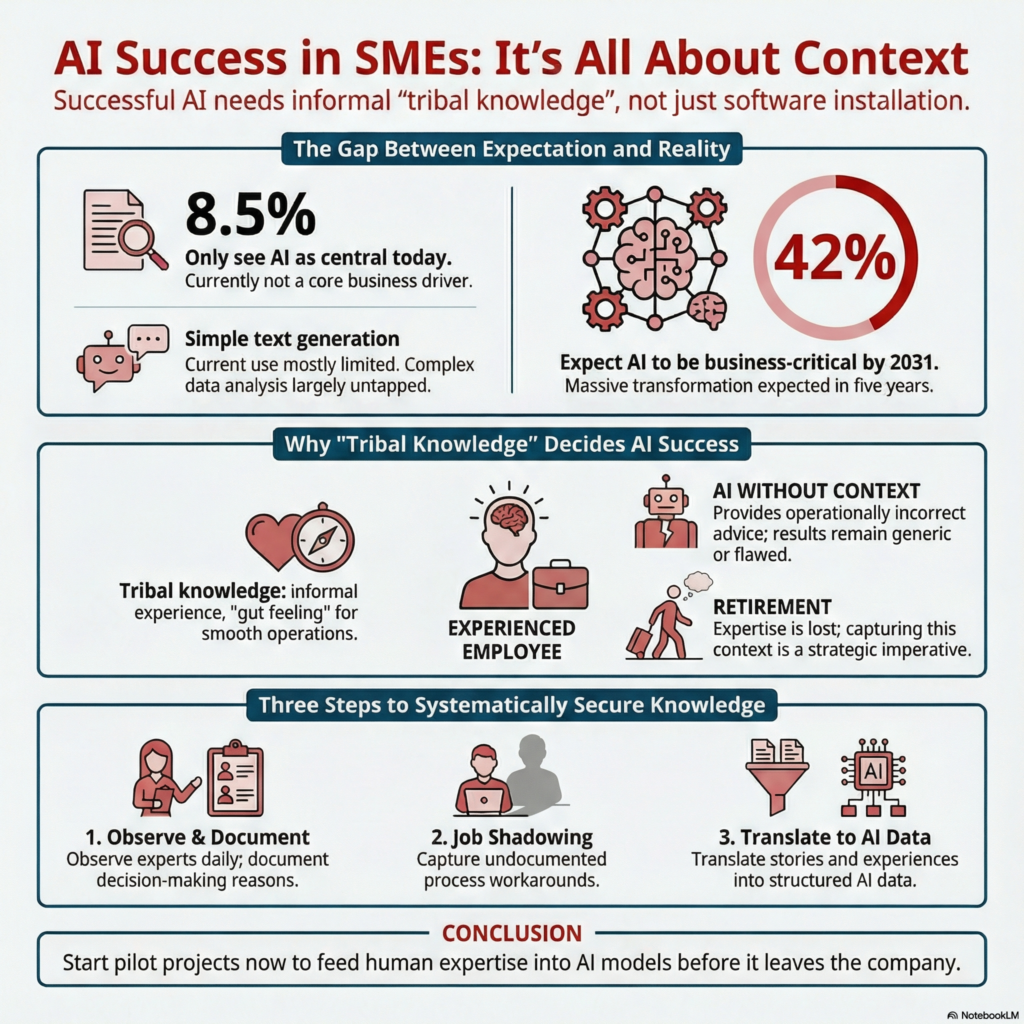
When organizations implement AI without capturing tribal knowledge, they create systems that work in theory but fail in practice.
The Urgency: Knowledge Walking Out the Door
The tribal knowledge problem is becoming more urgent for two reasons: workforce transitions and the speed of AI adoption.
Many industries face significant workforce transitions as experienced employees retire or move on. When they leave, decades of accumulated knowledge disappears. Organizations might conduct exit interviews, but these rarely capture the depth of operational knowledge that employees have internalized. How do you ask someone to explain everything they know when they don’t consciously recognize half of what they’ve learned?
Meanwhile, AI adoption is accelerating. Organizations are implementing AI systems now, making decisions about what context to provide and what to leave out. If tribal knowledge isn’t captured and shared during implementation, these systems will be built on incomplete understanding. Fixing this later is much harder than getting it right during initial implementation.
The combination is particularly challenging. Organizations are implementing AI to compensate for workforce transitions and knowledge loss, but they’re doing it without first capturing the knowledge they’re trying to replace. It’s like digitizing a library by scanning only the card catalog while the actual books are being discarded.
Surfacing the Invisible: Approaches That Work
Making tribal knowledge visible requires deliberate effort. It doesn’t happen naturally because experienced employees often don’t consciously recognize what they know that others don’t.
The most effective approach is structured observation combined with targeted questioning. Rather than asking employees to document their knowledge, observe them working and ask questions about specific decisions and actions.
When a quality inspector flags a batch for additional testing, ask why. The answer might start with “it just doesn’t look right,” but with patient questioning, you can surface specific cues they’re responding to. When a customer service rep escalates an inquiry that seems routine, ask what signaled that escalation was needed. When a maintenance technician says a machine will probably fail soon despite all indicators being normal, ask what they’re noticing.
This questioning works best when it’s continuous, not episodic. Building tribal knowledge capture into regular workflows is more effective than one-time knowledge transfer projects. After-action reviews, where teams discuss what happened and why decisions were made, naturally surface contextual knowledge. Decision journals, where people briefly note why they chose a particular course of action, capture reasoning that would otherwise be lost.
Job shadowing provides another powerful technique. Having someone follow an experienced employee for a day or week makes visible all the small adjustments, informal checks, and pattern recognition that experienced people do automatically. The observer can ask questions in real-time rather than trying to reconstruct thinking after the fact.
Exit interviews deserve particular attention. When employees leave, organizations have a narrow window to capture knowledge that’s about to disappear. Effective exit interviews for knowledge capture go beyond standard HR questions to explore specific situations, decisions, and patterns. What should your replacement know that isn’t documented? What surprises did you encounter when you started this role? What do you do differently now than you did a year ago, and why?
Cross-training programs also surface tribal knowledge, though not always intentionally. When experienced employees train others, they reveal decision-making patterns and contextual factors. Creating space for these training conversations and documenting what emerges captures knowledge that might otherwise remain tacit.
The key across all these approaches is making the invisible visible through structured attention. Tribal knowledge doesn’t emerge from asking people to write down everything they know. It emerges from observing their work, questioning their decisions, and creating opportunities for them to articulate knowledge they may not realize they possess.
From Capture to Context: Making Knowledge Usable
Surfacing tribal knowledge is only the first step. Making it usable for AI implementation requires translation and structuring.
Raw tribal knowledge often takes the form of stories, observations, and situational examples. An experienced employee might explain: “When Customer X calls about billing issues, it’s usually because their internal system has a specific quirk in how it processes our invoices, so we need to format things slightly differently for them.”
For AI implementation, this needs to become structured context that systems can use: Customer X requires invoice format variation due to internal system constraints. Customer service protocols should route their billing inquiries to specialists familiar with this requirement.
This translation doesn’t require sophisticated technical work. It requires thinking about how the knowledge would be useful in decision-making contexts. When would this information matter? What decisions would be different if someone had this knowledge versus if they didn’t? What patterns does this represent that might apply to similar situations?
Organizations that do this well create shared repositories where tribal knowledge is captured, structured, and made accessible. These don’t need to be elaborate systems. A well-maintained wiki where people document “things you should know about X” often works better than complex knowledge management platforms.
The goal is making tribal knowledge sharable. Once it’s visible and structured, it can be provided as context when implementing AI systems. The procurement AI can be given information about supplier relationship factors that aren’t in transactional data. The scheduling AI can be provided with machine quirks and technician capabilities. The customer service AI can access customer-specific patterns and preferences.
The Strategic Imperative
Capturing tribal knowledge is often treated as a nice-to-have activity that organizations will get to eventually. This is a mistake. In the context of AI implementation, it’s a strategic imperative.
Organizations implementing AI without tribal knowledge are building on incomplete foundations. The systems they create will be technically sophisticated but contextually blind. They’ll optimize for what’s measurable while missing what actually matters.
The opportunity cost is significant. Every month of AI usage without proper context is a month of suboptimal recommendations, missed opportunities, and frustrations that erode confidence in AI systems. Every experienced employee who leaves without their knowledge being captured is institutional wisdom permanently lost.
The organizations that will succeed with AI aren’t necessarily those with the most advanced models or the biggest technology budgets. They’re the ones that recognize tribal knowledge as a strategic asset and build systematic practices to surface it, structure it, and share it.
This work starts with recognition. Your most valuable AI context isn’t in your databases or documentation. It’s in the heads of your experienced employees, expressed in the small adjustments they make, the patterns they recognize, and the judgment calls that make operations actually work.
Making this knowledge visible isn’t a one-time project. It’s an ongoing practice of observation, questioning, documentation, and sharing. It requires creating space for experienced employees to articulate what they know, mechanisms to capture it, and discipline to structure it in ways that AI implementations can use.
The tribal knowledge exists. The question is whether you’re making it visible before it walks out the door.
Sources
Shah, Dharmesh. “The Three Quotients of Agent Success.” simple.ai by @dharmesh, January 21, 2026.
Want to learn more about your AI journey?
Let’s discuss how we can support you on your AI journey.

How is AI rewriting the headcount vs value creation equation? | NordAGI
[…] feedback loops, documented contextual knowledge — an aspect explored further in our article on why tacit operational knowledge is the blind spot of every AI implementation —, clearly defined data standards, early involvement of production teams, and real-time […]
AI in Manufacturing – Different Shop Floor, Similar Challenges?
[…] both digitalised, structured data and clearly defined processes. The parallel is direct: “AI cannot augment what hasn’t first been systematised” – this holds true at the desk just as it does on the production line. A 2025 white paper […]
The Imagination Gap – Why Imagination Is the Real Bottleneck for Successful AI Implementation
[…] second mechanism concerns blind spots – or, to put it more precisely: things one does not even know one does not know. Organisations fail to recognise the explorative and… because, without first-hand AI experience, they simply cannot envision what AI could make possible […]