



“This prompt made my marketing agency redundant”, “The 17 best marketing prompts that are guaranteed to work” or “These unique prompts put you ahead in content marketing”. Anyone active on LinkedIn, YouTube or similar platforms encounters promises like these on a daily basis. The offer: prompt collections for every social media scenario, for blog articles, newsletters, landing pages – all packaged in an appealing infographic, all ready to use immediately. The positioning makes sense, as “marketing” is one of the central use cases for AI, capable of delivering not just ideas but finished content on the spot.
Marketing prompt collections deliver quick results – but without company context, tonality guidelines and a structured workflow, the output sounds interchangeable.
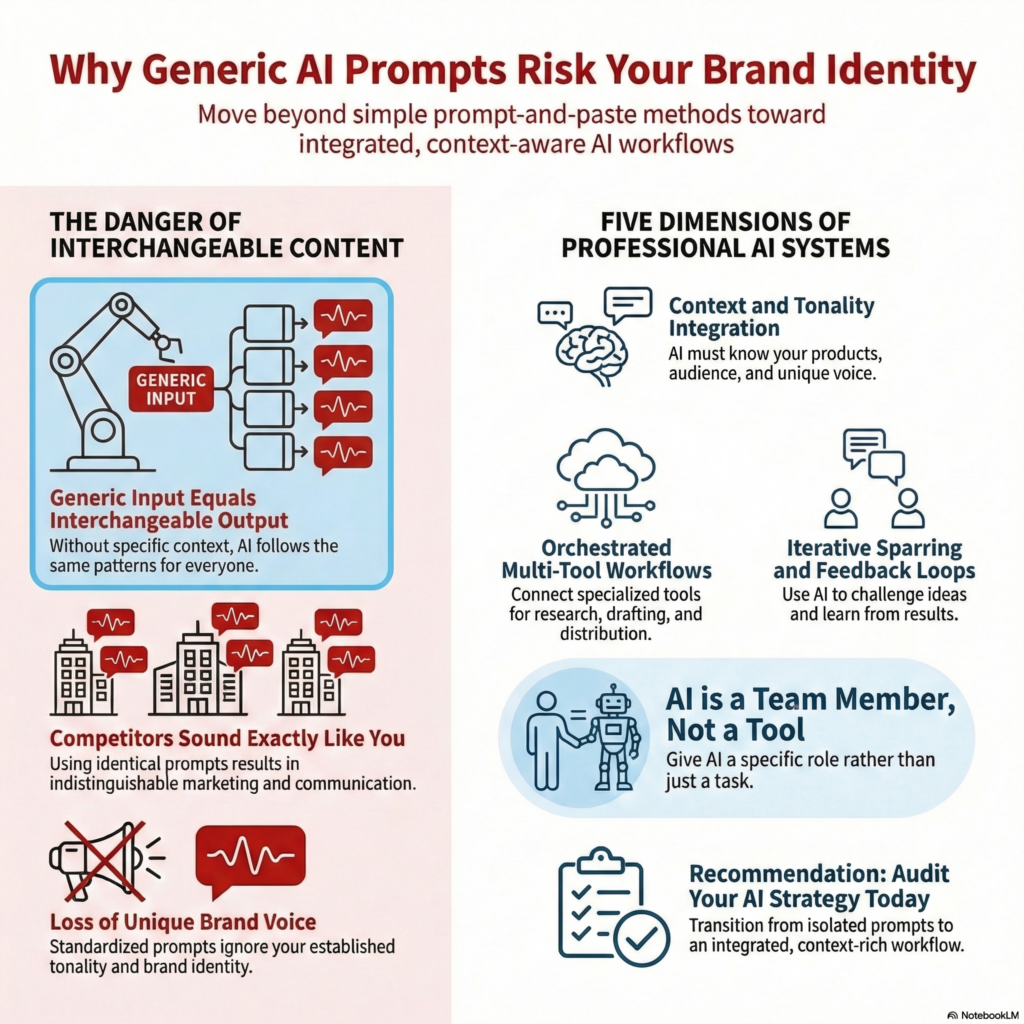
Regardless of which AI tool is used, generic input leads to generic output. The difference between a single prompt and an orchestrated system lies in five dimensions
- context
- tonality
- workflow
- iteration
- feedback
What is remarkable about these prompt collections is that they work – at least at first glance.
They produce a text or a graphic. The text reads fluently. The graphic looks professional. Everything is there: structure, keywords and a call to action. For many who are taking their first steps in AI-supported marketing, this is a genuine moment of revelation.
Our thesis: perhaps that is precisely where the problem lies. Not with the prompts themselves. But with what they promise yet structurally cannot deliver.
Would you like to try a thought experiment?
Consider a typical marketing prompt from one of these collections:
“Write a conversion-focused blog article on the topic [X] using the keyword [Y]. Use a clear structure with an introduction, subheadings and a call to action that encourages the reader to book an introductory meeting with us.”
Now imagine that an engineering firm in Stuttgart uses this prompt. A care provider in Hamburg does the same. As does an accountancy practice in Vienna. All three receive a blog article. All three read professionally. And all three sound the same – or are at least structurally very similar. Whether they use the same AI tool or different ones makes little difference: without specific context, all AI systems draw on the same learned patterns.
Take it one step further: two engineering firms in Baden-Württemberg, direct competitors, use the same prompt – perhaps even in different AI tools. Both publish the result. The texts differ in detail but not in substance. Could there be a risk that their corporate communications become interchangeable? Not because the AI works poorly. But because a context-blind prompt produces context-blind output.
This pattern applies to almost every marketing prompt in these collections, whether the task is optimising a landing page, preparing emails or newsletters, or planning entire campaigns. Generic input leads to professional-sounding but structurally interchangeable output.
The decisive question is: how well do these results align with a carefully developed corporate identity?
Does the AI-generated blog article sound like the brand voice that has been built over years? Does the AI infographic genuinely match the visual identity that a design team has created? Or does a parallel world quietly emerge – one that presents itself professionally but ultimately has little to do with the actual corporate identity?
From prompt to professional workflow: five dimensions that make the difference
To be fair, prompt collections are a starting point – and as such, they have their value. They demonstrate what is possible, lower the barrier to entry and encourage through early visible results.
What they do not show is what needs to come before and after, so that reliably replicable results can emerge through an efficient workflow.
In our daily practice, rather than relying on a single prompt within one AI tool, we use a coordinated ecosystem of different AI tools and instructions.
- One for ideation and campaign planning
- Another for research
- A further one for copywriting and strategic sparring
- Yet another for image generation
Beyond this, all tools share the necessary project knowledge and thus the company-wide context. This includes the tonality guides anchored within it and the actual workflow instructions that govern, among other things, how a blog article becomes a LinkedIn post, a carousel or a newsletter contribution.
The difference between “one prompt that generates the entire blog post” and an orchestrated system can be understood through five dimensions.
Context: Who are we? What do we offer? Which audience are we addressing? An AI that does not know these things writes marketing for everyone – and therefore for no one. Context here means that the AI knows the organisation: its positioning, its products, their strengths and the market in which it operates. Without this knowledge, the AI can only anticipate. And anticipation frequently leads to generic results.
Tonality: Every organisation has its own voice. In marketing, this voice is particularly important – it conveys the company’s identity. This voice develops over years, across the website, in brochures, in client conversations. A context-free standard prompt simply cannot know this voice.
The result: the AI-generated blog article sounds different from the language used on the website. The LinkedIn post sounds different from the sales presentation.
The consequence: corporate communications become increasingly inconsistent – because the feedback that has flowed into the brand voice over years has simply never reached the AI.
Workflow: In reality, a marketing article is not an isolated product. It emerges through a process: ideation, research, drafting, revision, approval. And it lives on as a LinkedIn post, a carousel, an infographic, a newsletter teaser. A single prompt cannot capture this process. In practice, this means one AI tool writes the text, another creates the infographic, a third generates the title image. Each step has its own requirements regarding length, structure, tone and visual design. And each step requires its own instructions that reference the company context and tonality.
Iteration: Good marketing content rarely emerges on the first attempt. Those who use AI solely as an order-taker – “write this for me” – potentially miss the greatest advantage an AI can offer. It can, for example, challenge assumptions: does the structure suit the audience? Is a perspective missing? Is the opening compelling enough? For this, however, the AI needs to be assigned a different role and a different standing than that of an uncritical text producer. Instead, it must become a sparring partner that thinks alongside rather than merely executing. The difference sounds marginal. In practice, it fundamentally changes the quality of the results.
Feedback: An AI system remembers and learns as a result. An isolated prompt does not. When the AI receives the finished article, the LinkedIn posts derived from it and the responses to those as reference material, it increasingly understands what worked and what did not. It recognises patterns. It becomes more precise. Without this feedback loop, it starts from zero every time – regardless of how well the prompt was written.
The real question: AI as text producer or team member?
Behind the question “a prompt or a workflow” lies a more fundamental decision: what role do you assign to AI within your team?
Most prompt collections are based on one model: the person gives a command, the AI executes. This is the classic text-producer model, equally applicable to “revise my email” or “translate my text”.
There is, however, another way. An AI that knows the organisational context and serves as a sparring partner operates on an entirely different level. It can critically question a draft before publication. It can flag that an argument does not resonate with the target audience or that a perspective is missing. It can weigh different variants against one another and explain which better suits the brand voice. It can check at the end of a production process whether the finished article meets the tonality guidelines. This is not rocket science. It is our daily practice – provided the AI has the necessary context and the right role.
The difference between text producer and team member is not a technical one. It is a deliberate decision about how much context, structure, and responsibility you give the AI. A prompt gives it a task. A system gives it a role.
Five prompts for thought
Rather than falling into the “we solve everything with a single blog post” mindset, we would prefer to leave you with the following reflections:
If your marketing team were to work with one of these “universal” prompts tomorrow, would the result sound like your organisation? Or merely like any other business in your sector?
Does the AI your team works with know your positioning, your target audience and your tonality? Or does it start with a blank page every time?
What happens after the first output? Is there revision, quality control, a feedback loop – or is the first draft simultaneously the final product? Alternatively: are changes made but never fed back to the AI?
Does your team use AI as a text producer or as a sparring partner? Does the AI actively challenge assumptions – or does it simply agree with everything?
And perhaps the most important question: does the AI in your marketing improve over time – or will it produce the same output tomorrow, in the same quality as yesterday?
The point is not to disparage prompt collections. They are a good starting point. But a starting point is not yet a robust workflow. We are convinced that what applies to the example of marketing applies equally to all other uses of AI within an organisation. And the businesses that understand this difference will notice it – not only in their communications.
Would you like to strategically implement AI in your daily business operations?
The question is: What does this look like in your company? Do your employees have the competencies they need for this new work reality? Or are AI integration and competency development currently happening side by side – without systematic connection?
In a no-obligation strategy session, we would be happy to introduce you to the NordAGI approach.