



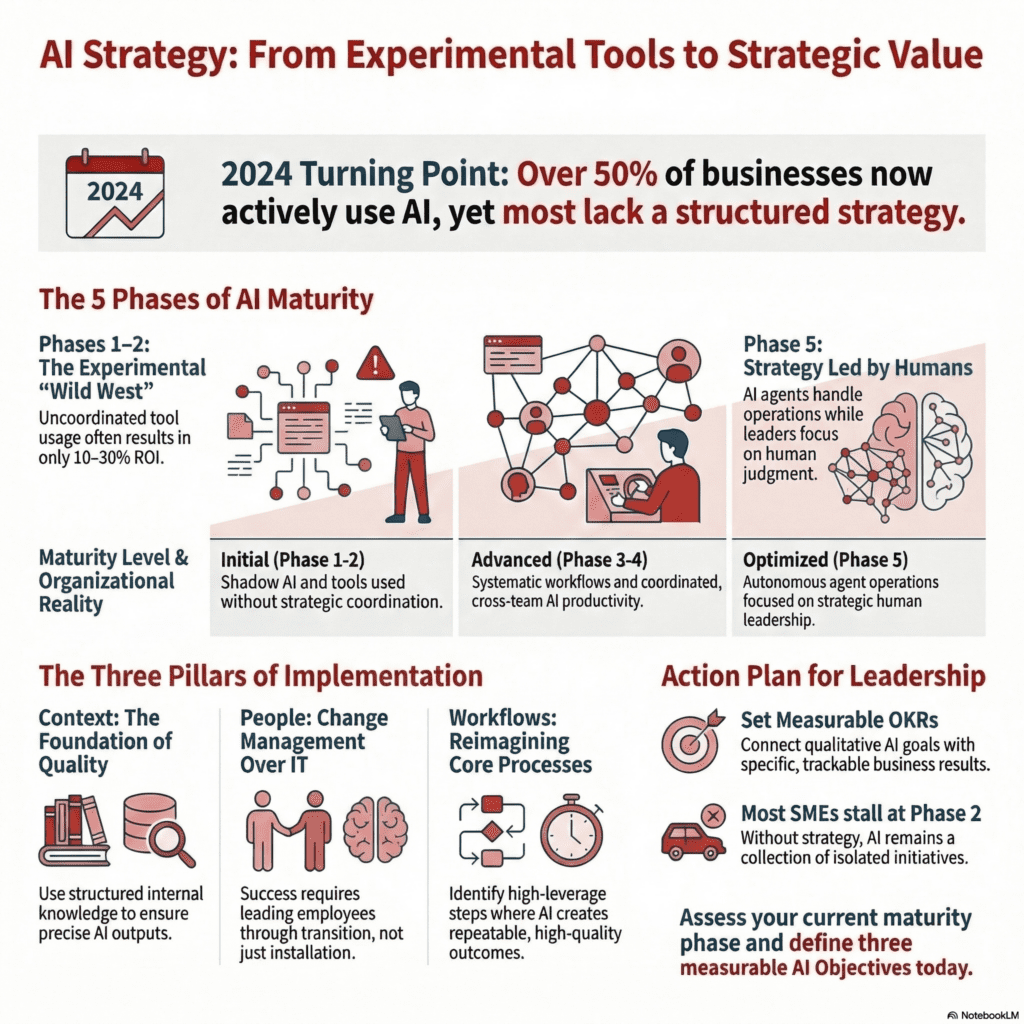
The German industry association Bitkom has been tracking AI adoption in German businesses for years. The figures point to a clear trend: just a few years ago, AI was not on the agenda for the majority of organisations. 2024 marked a turning point — for the first time, more than half of all businesses were actively engaging with AI. The trend continues and confirms that AI has arrived in the world of SMEs and family businesses.
Why SMEs and family businesses need an AI strategy
Yet the fact that AI is on the agenda does not mean it is being approached in a structured way. What we observe in practice: many organisations experiment with AI, purchase licences, launch pilot projects — but without a clear direction.
Answers to fundamental questions are often missing:
What do we want to achieve with AI? Which areas do we prioritise? Where does AI have the greatest leverage in our organisation? Have we considered all relevant use cases — or does our understanding of AI stop at text improvement and translations?
AI can be far more than an advanced word processor: a sparring partner on equal footing that supports strategic decision-making. A closer look quickly reveals that these are fundamentally different use cases with very different potential. Equally relevant are questions around who is actually responsible for AI adoption within the organisation, and how the success of AI implementation is ultimately measured.
Leadership sees the potential and pushes for rapid progress. At the same time, concerns are growing among employees: What does AI mean for my job? For my role? This gap between the leadership team and the workforce is not a communication problem — it is the symptom of a missing strategy, one that must also incorporate change management to bring employees along through the transition.
This is precisely where an AI strategy creates the necessary clarity. Without one, AI implementation often remains a collection of isolated initiatives that never achieve the expected leverage. Employee concerns go unanswered — a direct consequence of insufficient change management. This is why NordAGI’s approach treats AI implementation not merely as an IT challenge, but primarily as a change management undertaking.
AI strategy as the link between corporate strategy, digitalisation strategy, and business processes
An AI strategy does not exist in isolation within an organisation. It connects several strategic levels: the overarching corporate strategy, an existing digitalisation strategy, the IT strategy, and operational business processes. Its particular value — and its particular challenge — lies in this function as a strategic link.
The decisive difference compared to other strategic initiatives: AI is not a gradual improvement but a disruption. Whilst traditional digitalisation topics often optimise individual processes or introduce new tools, AI fundamentally changes how decisions are made, how knowledge is used within the organisation, and how employees work.
AI is therefore closer to the core of the business model than most other technological changes, affecting business processes not just selectively but with the potential to be relevant across every part of the organisation. Put differently: new accounting software changes a process. AI can change how the entire organisation operates.
This is also why AI strategy deserves its own dedicated treatment — with its own objectives, its own resources, its own governance. It supports both the corporate and the digitalisation strategy. That is why it amounts to more than a sub-section in a broader strategy paper.
An AI strategy does not exist in isolation within an organisation. It connects several strategic levels: the overarching corporate strategy, an existing digitalisation strategy, the IT strategy, and operational business processes. Its particular value — and its particular challenge — lies in this function as a strategic link.
The 5-phase model: Establishing your starting point
Before a strategy can be developed, the current situation must be clear. An AI strategy for an organisation that is just starting out looks different from one for an organisation that has already achieved its first systematic successes.
We distinguish five phases of AI maturity that organisations typically progress through. These phases help determine the current position — and realistically assess which next steps make sense.
Phase 1: “The Wild West” Uncoordinated AI experiments without strategic direction. Various tools are tested in parallel, with no clear success metrics or coordination. “Shadow AI” emerges — usage that bypasses the IT team, without guidelines, without organisational learning.
Phase 2: “Copilot purchased, problem not solved” Software licences have been procured, but without systematic rollout or change management. Tools are used sporadically, and the hoped-for efficiency gains fail to materialise. Typical ROI: 10–30% of potential.
Phase 3: “AI as a personal sparring partner” Individual leaders and employees use AI strategically for decisions and problem-solving. The context is right, prompts are well considered, and the first systematic workflows are taking shape. This is where genuine productivity gains begin.
Phase 4: “Multiplayer AI teams” Teams work with AI in a coordinated manner. Shared knowledge, consistent standards, standardised prompts, and cross-team workflows. The efficiency gains become clearly noticeable.
Phase 5: “Human-led, agent-operated” AI agents handle operational tasks autonomously. People focus on strategy, leadership, and decisions that require human judgement.
Why this classification matters: each phase presents its own challenges and calls for different strategic priorities. An organisation in Phase 1 first needs orientation and clear guidelines. An organisation in Phase 2 needs to understand why purchased tools alone are not delivering the expected results. The strategy must match the maturity level — otherwise it remains a theoretical construct with no practical impact. An honest diagnosis is the first step. Our experience shows that most organisations find themselves between Phase 1 and Phase 2. And many underestimate how far the journey to Phase 3 and beyond actually is.
What makes a good AI strategy?
A well-crafted AI strategy, developed specifically for the organisation, is characterised by several elements. A two-page position paper or a brief “AI manifesto” typically cannot meet these requirements.
Clear strategic alignment
The AI strategy answers which corporate objectives AI should support. A structured approach has proven effective here — for example, using OKRs (Objectives and Key Results). OKRs are an established tool for corporate governance that connects qualitative goals with measurable outcomes, widely used in successful organisations for strategic planning.
First, qualitative objectives are defined — the Objectives. For example, “we want to accelerate our proposal process through AI” or “we want to compensate for the skills shortage in customer service through AI support.”
Then come measurable indicators — the Key Results. For example: “reduce turnaround time for proposals by 40%” or “handle 30% more customer enquiries with the same headcount.”
Finally, metrics are established against which goal achievement is measured. This enables not only progress tracking but also an honest assessment of whether the strategy is working — or needs adjustment.
Four perspectives for implementation
An effective AI strategy considers four levels:
The context level forms the foundation. This is where organisational knowledge is captured and structured: industry expertise, process documentation, customer understanding, internal standards. Without this context, AI delivers generic results that rarely hit the mark. The quality of the output depends directly on the quality of the context provided.
The people and team level clarifies how employees and teams should use AI. What empowerment is necessary? Which competencies need to be developed? How can organisations ensure that genuine capability building takes place instead of shadow AI — first at the individual level, then across teams?
The workflow level identifies which processes can be supported by AI. Which processes are adapted, which completely reimagined? Which ones are worth the investment at all? This is where structured context meets defined work steps to produce repeatable, high-quality outcomes.
The automation level examines which core processes can benefit from AI automation to achieve genuine efficiency gains — not as workflow support, but as independent process execution by AI agents.
Governance and responsibilities
Who is responsible for AI implementation? Is it the IT department, the managing directors, a dedicated role? A good strategy clarifies responsibilities, decision-making paths, and resource allocation. AI implementation is a leadership task — we explore why in the section on change management.
The path to an AI strategy: The approach
Developing an AI strategy follows a structured approach. The key steps at a glance:
Assessment: Where does the organisation stand within the 5-phase model? Which AI initiatives already exist? Which processes are documented, and what organisational knowledge exists in what form?
Goal definition: Define concrete, measurable outcomes that align with the corporate strategy — ambitious yet realistic.
Prioritisation: Which initiatives promise the greatest benefit? Which can be implemented with available resources? Which lay the groundwork for future initiatives?
Roadmap development: Arrange milestones, resource requirements, and dependencies into a timeline — as a living document that is reviewed regularly.
Change management: Plan in parallel how the organisation will be prepared for the changes ahead. This point is so central that it deserves its own section.
Why AI strategy means change management
Many organisations treat AI implementation as an IT project. This is an avoidable mistake. AI implementation is not just a technology project — it is a change management project.
The technology works. What does not work automatically: bringing people and processes along. The investment in change management must therefore be at least on a par with the investment in technology — many successful transformations show that it should be considerably higher.
Why is that? The answer lies in the different perspectives within the organisation.
The leadership level typically focuses on opportunities and risks: productivity gains, competitive advantages, compensating for the skills shortage. This generates enthusiasm and the desire to move quickly.
At the employee level, other questions often dominate: Will AI make my job redundant? Can I learn fast enough to keep up with the new systems? How will my daily work change? These concerns are legitimate and must be taken seriously.
Both perspectives are valid — and both must therefore be addressed in the strategy. A good AI strategy does not turn AI into a threat, but into a tool. It demonstrates how AI can secure jobs — by compensating for the skills shortage, by relieving employees of routine tasks, by increasing individual productivity.
This requires transparent communication, genuine involvement, and sufficient time for capability development. AI demands new skills from everyone — from senior leaders to administrative staff.
This is also where it becomes clear why a two-page position paper cannot do justice to these requirements. A genuine AI strategy manages the inherent complexity of the topic. It creates a framework in which opportunities are seized, risks are mitigated, and concerns are taken seriously.
Why does AI implementation fail without a strategy — and what does a structured approach look like?
Developing an AI strategy can seem daunting at first. That is precisely why a structured process matters: understand the starting point, plan the next steps, proceed systematically and with clear priorities.
For AI implementation to deliver measurable value, it must be understood as a transformation process — one in which the tools play a role, but a secondary one compared to everything else. The real work lies in the strategy: clear objectives, considered prioritisation, and above all, serious change management.
This is more demanding than a two-page position paper. But it is the difference between an empty gesture and genuine strategic work that moves the organisation forward.
Would you like to strategically implement AI in your daily business operations?
We work alongside organisations in developing and implementing their AI strategy — from assessment through to roadmap. A good starting point could be our AI Strategy Development programme or the AI Readiness Assessment.
In a no-obligation strategy session, we would be happy to introduce you to the NordAGI approach.
How is AI rewriting the headcount vs value creation equation? | NordAGI
[…] However, a significant implementation gap stands in the way. Christina Raab, Managing Director of Accenture Germany, noted at the World Economic Forum in Davos that fewer than half of employees feel prepared for working with AI. Particularly problematic is the lack of communication: only a very small proportion report that their leaders discuss what AI concretely means for their day-to-day work [1]. This silence generates uncertainty and slows the pace of adoption. This is precisely where an approach we call “Leadership First” comes in: equipping the leadership team to understand and model AI strategically before the organisation-wide rollout begins — a principle described in more detail in our article on AI strategy for SMEs. […]
The Imagination Gap – Why Imagination Is the Real Bottleneck for Successful AI Implementation
[…] a shortage of talent and knowledge, but the widespread difficulty organisations face in envisioning where AI could concretely contribute to their business processes […]