


The AI discourse is loud, often driven by opinion, and the available data is heavily technical. The good news: that is beginning to change.
Business leaders in SMEs and family businesses who engage with artificial intelligence in early 2026 face a familiar problem: there is no shortage of opinions. LinkedIn and other platforms produce a daily stream of predictions about which professions will disappear, which skills will prove indispensable, and why entire industries will be unrecognisable within three years. In between: the by now ritual cycle of tool recommendations and hype.
Those who look a little deeper encounter two additional layers. One consists of specific tutorials and explanations: How to optimise marketing with AI. How to build an agent to automate business processes. What the difference is between an LLM and a RAG system. Useful for specialist teams, certainly, and a window into what AI can do, but focused on individual use cases and lacking a strategic framework. The other layer is technical: which language model scores how in which benchmark. Relevant for developers, but hardly actionable for a managing director.
What we find missing in this discourse is the perspective of the leadership level. Senior leaders have different responsibilities. Optimising prompts and memorising benchmarks is not among them. They need to identify which use cases within their organisation lend themselves to AI, make strategic decisions about AI adoption, and take their organisation along a path whose destination is still taking shape. Opinions can contribute to that process, but what matters more is reliable information.
NordAGI follows this discussion closely. Over the past weeks, we have assessed a range of voices and studies that examine the current state of AI from different angles, from international thought leaders and large-scale research to observations from our own consulting practice and our own daily use of AI.
Our conclusion: in early 2026, three signals stand out as particularly relevant for AI strategy in SMEs and family businesses. Taken individually, each is one observation among many. Taken together, they create a clear leverage effect, one that points towards a concrete mandate for business leaders.
TL;DR:
The AI discourse is dominated by opinions, department-specific tutorials, and technical benchmarks. What is missing is the strategic perspective that business leaders need. We have assessed recent studies and voices and identified three observations that reinforce one another: first, AI is shifting the value of knowledge work, away from standardisable tasks and towards domain expertise and problem formulation. Second, a study of over 80,000 AI users shows that 81 per cent already experience tangible benefits, whilst the DACH region is somewhat more sceptical than the global average. Third, AI amplifies existing structures but does not improve them; without documented processes and codified knowledge, AI lacks a foundation to work from. For SMEs and family businesses, the implication is clear: AI adoption is not an IT project. It is a leadership responsibility.
How is AI changing the value of knowledge work?
That depends on the type of knowledge work. American productivity expert Tiago Forte has recently articulated a thesis that is striking in its clarity: certain types of knowledge work, everything that has historically commanded a premium as cognitive labour, is becoming dramatically cheaper through AI. More specifically: whatever AI can automate, scale, or generate loses monetary value. Forte compares this to a sudden price collapse in a universally used commodity. Knowledge work flows into virtually every product and service. When this input becomes many times cheaper, the consequences for all downstream value creation are fundamental.
Paradoxically, other aspects of knowledge work are simultaneously gaining in value. Not the standardisable, reproducible kind, but the kind that cannot be translated into algorithms: the ability to formulate problems in the first place, rather than merely finding answers. Or the creativity to recognise where action is needed and develop better approaches before solutions are even sought.
What does this mean for SMEs and family businesses?
To put these observations into context: Forte’s analysis is oriented towards individual career development. Translated into a business context, however, a strategic question emerges: where does the competitive advantage of your organisation lie, once standard cognitive work becomes equally cheap for every competitor?
The answer lies in what makes your organisation unique: in-depth domain knowledge, established client relationships, industry-specific expertise, and the tacit process knowledge that resides in the minds of your most experienced employees.
This is precisely where AI falls short without human leadership. Without domain knowledge, without an understanding of the specific organisational reality, AI produces generic outputs at best: technically correct, but often without particular strategic value.
And here a sense of urgency arises that has less to do with technology than with leadership: in many SMEs and family businesses, the employee cohorts who built this knowledge over decades and bring it to bear as subject-matter experts every day will retire within the next five to ten years. Organisations that fail to use this window to codify tacit knowledge and embed it organisationally will lose not only experience, but also a central foundation upon which AI could generate meaningful business value.
The same applies on a smaller scale to routine employee turnover: every person who leaves an organisation and takes undocumented process knowledge with them leaves a gap behind. The demographic shift merely escalates this problem to a systemic level.
What do 80,000 AI users report about their experiences?
Assumptions and opinions tend to dominate the AI discourse. All the more remarkable, then, is a study published by Anthropic in March 2026. Over the course of a single week in December 2025, a specially developed AI version interviewed more than 80,000 people across 159 countries and 70 languages about their hopes and concerns around AI. According to the authors, it is the largest and most linguistically diverse qualitative study ever conducted on this topic. The systematically gathered data paints a considerably more nuanced picture than most online commentary. Several findings are particularly relevant for business leaders.
Finding 1: The opportunities are not hypothetical.
The study first asked respondents to describe their personal vision for AI: what should AI ideally do for them? It then asked whether AI had already taken a concrete step towards that vision. The result: 81 per cent said yes. The most frequently cited realised benefits relate to productivity gains (32 per cent), cognitive partnership, meaning AI as a thinking and problem-solving sparring partner (17 per cent), and learning and skills development (10 per cent).
On the aspiration side, the picture is revealing: the largest share of respondents (19 per cent) wants what the study terms “professional excellence”, the ability to delegate routine tasks to AI in order to focus on strategically valuable work. What is noteworthy, however, is what lies behind the productivity wish for many respondents: not more output, but quality of life beyond work. 11 per cent simply want AI to give them the time to be with family, pursue interests, or rest. What initially appears to be an efficiency topic turns out, for many people, to be a deeply personal concern.
Finding 2: Hopes and fears coexist.
The study identifies a pattern that Anthropic calls “Light and Shade”: the very same AI capabilities that deliver tangible benefits simultaneously generate the greatest anxieties. This is most evident in the area of the economy and employment.
28 per cent of respondents see AI as a lever for economic independence. In the study, these are primarily freelancers, small business owners, and employees with side projects who use AI as a multiplier. Translated into the context of SMEs and family businesses: these are potentially your highest-performing employees, those who see opportunity in AI and independently find ways to use it productively. At the same time, 18 per cent fear losing their job to AI. These are potentially those in your workforce who experience change not as an opportunity but as a threat, and who, if their concerns go unaddressed, will actively or passively slow the transformation process.
The study further shows that concern about economic impact is the single strongest predictor of an overall negative attitude towards AI.
For business leaders, this means two things: first, the AI anxieties within your workforce are not irrational; they deserve an honest response. Second, the willingness of many employees to use AI productively is an asset that can be deliberately cultivated. Ignoring either side, the fears or the readiness, means leaving strategic potential untapped.
Finding 3: Efficiency gains are not automatic.
19 per cent of respondents report a phenomenon the study terms “illusory productivity”: AI saves them time on individual tasks, but expectations rise proportionally. The treadmill simply turns a little faster, and the breathing space that efficiency gains were supposed to create fails to materialise.
This mechanism is not limited to freelancers. In every organisation, the question arises: what happens with the time AI frees up? Is it invested in higher-value work? Or does it quietly fill with additional tasks that nobody explicitly commissioned? Leaders who do not consciously steer how freed-up capacity is used risk efficiency gains silently converting into overwork [LINK: AI relieves pressure and simultaneously tempts overwork].
Finding 4: The DACH region is somewhat more sceptical by global comparison.
Globally, 67 per cent of respondents view AI positively. In Germany, this figure stands at 64 per cent, in Switzerland likewise at 64 per cent, and in Austria at 66 per cent. Western Europe as a whole shows slightly below-average approval. By comparison: in Latin America, Sub-Saharan Africa, and much of Asia, approval rates range between 70 and 85 per cent.
The study offers possible explanations: in emerging economies, AI is perceived more as a vehicle for advancement, a way to build businesses without traditional start-up capital or to overcome educational barriers. In wealthier regions, concern about economic disruption tends to dominate.
For SMEs and family businesses in the DACH region, this means: your employees, and quite possibly your leadership team, begin the AI journey with a degree of underlying scepticism. That is not inherently a disadvantage; healthy scepticism protects against poor decisions. It becomes a problem, however, when that scepticism blocks the transformation steps that are necessary.
Why can technology only amplify what already exists?
A recognition is surfacing with increasing frequency in the current discourse about AI in organisations, one that sounds banal at first glance but carries far-reaching consequences: AI does not improve structures. It amplifies existing ones.
In concrete terms: where decision-making pathways are clear, AI makes them faster. Where processes are documented and understood, AI can optimise and implement them. Where domain knowledge has been systematically captured, it becomes the context that makes AI outputs relevant and organisation-specific.
But the amplification logic works in both directions. Unclear responsibilities do not become clearer through AI; they either become visible more quickly or, worse still, are papered over by generic assumptions that nobody has questioned. Undocumented processes remain invisible to AI. Informal knowledge that exists only in the minds of individual employees is simply unavailable to AI. And meaningless processes? AI will cheerfully continue to execute them and even make them more efficient, without ever questioning whether the process contributes to value creation at all.
Without clarity about which processes genuinely create value and which merely represent historically accumulated habits, AI will accelerate the idle running rather than eliminate it.
In our own work with SMEs and family businesses, we see exactly this pattern repeatedly [LINK: The Imagination Gap]. Transferring knowledge therefore means converting informal process knowledge, the workarounds, the unwritten rules, the experiential values, the decision-making logic, into systematic process documentation. Not as a bureaucratic exercise, but as a strategic investment. Documented knowledge serves two functions simultaneously: it safeguards hard-won organisational knowledge against the consequences of demographic change. And it creates the context AI needs to generate genuinely organisation-specific value, rather than generic outputs.
And this is precisely why AI adoption is not an IT project.
If the prerequisite for a successful AI strategy in SMEs and family businesses is to clarify processes, codify knowledge, and sharpen decision-making architectures, then what is required is an organisational development project. It demands systematic support for the transition, clear leadership decisions, and the deliberate building of capabilities. Technology, to use the oft-cited rule of thumb, accounts for 10 to 20 per cent of the equation at best. The remaining 80 per cent falls to people and processes.
That sounds like more work than a software rollout. It is more work. But it is the work that makes the difference between wasted licences and genuine transformation.
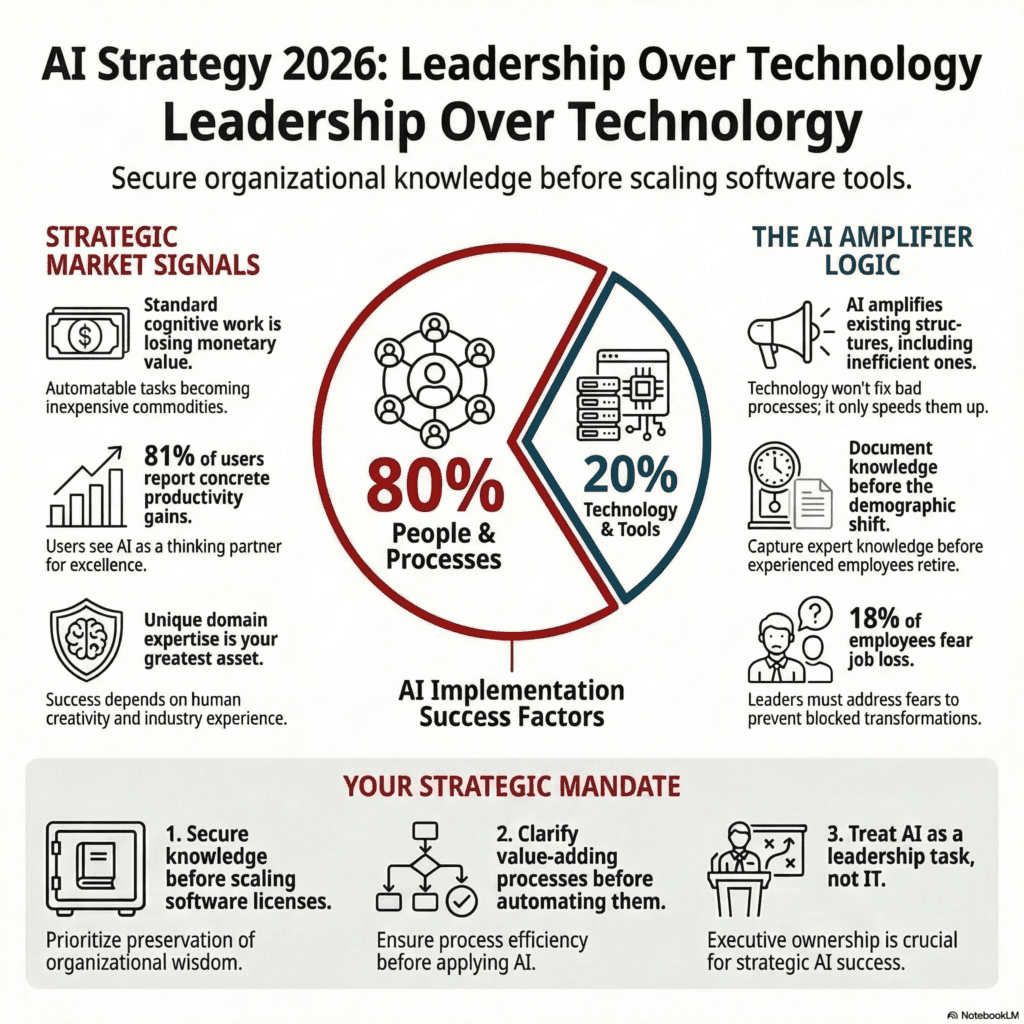
What do these three observations mean for AI strategy in SMEs and family businesses?
These three observations develop their real force when considered together, because they interlock: the shift in the value of knowledge work changes which capabilities and which knowledge will make the difference going forward. The data from the Anthropic study shows that this shift is not a future scenario but a present reality, one that people are already living with, hopes and anxieties alike. And the amplification logic determines whether your organisation benefits from this shift or is overtaken by it, depending on how robust the organisational foundation is.
Three areas of action emerge that we consider particularly relevant in early 2026:
1. Develop AI strategy on a solid foundation.
Before technology is purchased, three things need to be clear: which processes genuinely create value? What domain knowledge exists in what form, and where does it exist only informally? And what is the state of data quality on which AI is supposed to operate? An AI strategy that does not answer these questions is built on sand.
2. Secure and transfer knowledge.
In many organisations, experienced employees hold the informal knowledge that keeps processes running, not in documents but in their heads. With demographic change, these very knowledge holders will retire in the coming years. Organisations that have not converted this knowledge into documented process descriptions, SOPs, and decision-making logic by then will lose it irretrievably, leaving a gap that AI cannot fill either. The time to act is now, not eventually.
3. Establish AI as a leadership responsibility.
The Anthropic study shows: your employees hold both concrete hopes and real fears regarding AI. Actively managing this tension is neither a pure HR task nor an IT project. It is a leadership responsibility. This means: planning systematic support for the transition from the outset, not as an afterthought. Placing enablement before technology. And replacing the question “Which tool shall we buy?” with the question “What organisational conditions do we need to create?“
An early-2026 interim assessment, not a conclusion.
This article is a stocktaking exercise. It captures which signals we consider reliable in early 2026 and what conclusions we draw from them for SMEs and family businesses.
The signals will continue to evolve and may well shift. New studies will appear, new data points will emerge. Some of what currently counts as a well-founded assessment will prove correct. Other aspects will turn out to have been misjudged.
What is unlikely to change: successful AI integration begins with organisational prerequisites, not with software licences. It requires a willingness to clarify processes and secure knowledge before technology is scaled. And it succeeds only when business leaders take the tension between hope and concern within their workforce seriously and actively shape it.
If you would like to address these questions systematically, let’s have a conversation.
Sources:
[1] Tiago Forte: “The Skills AI Makes Less Valuable (and More Valuable)” (Video), 2026. https://youtu.be/69q-YigepWs
[2] Anthropic: “What 81,000 People Want from AI”, March 2026. https://www.anthropic.com/features/81k-interviews
Would you like to strategically implement AI in your daily business operations?
The question is: What does this look like in your company? Do your employees have the competencies they need for this new work reality? Or are AI integration and competency development currently happening side by side – without systematic connection?
In a no-obligation strategy session, we would be happy to introduce you to the NordAGI approach.